Werkseite · Syntagma Forschung
Lichtverschmutzung – der Überblick
Thomas Schüller · Syntagma Forschung · ORCID 0009-0003-9799-6747
Worum es geht
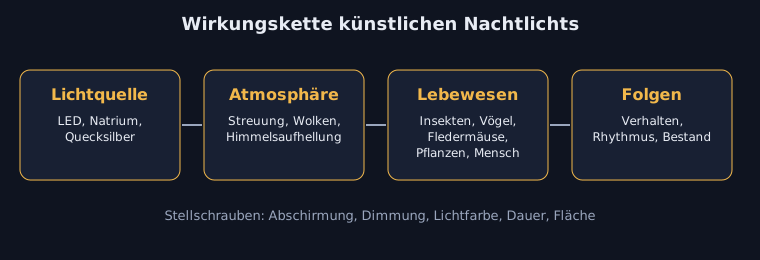
Wo es nachts hell ist, verändert sich mehr als nur der Blick auf die Sterne. Künstliches Licht bei Nacht wirkt auf Insekten, Vögel, Fledermäuse, Gewässer und Pflanzen, und es greift in die innere Uhr des Menschen ein. Dieser Überblick fasst den Stand der Forschung in sieben Fachpapieren zusammen und nennt, wo die Datenlage stark ist und wo nicht.
Die wichtigsten Aussagen
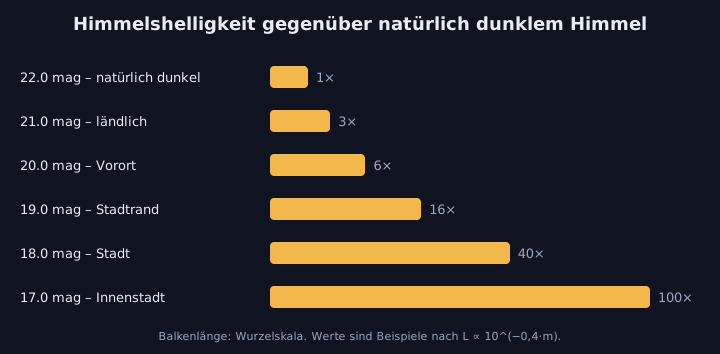
- Es wird heller. Über 80 Prozent der Weltbevölkerung leben unter lichtverschmutztem Himmel, in Europa über 99 Prozent. Die beleuchtete Fläche wächst jährlich um rund 2 Prozent, die Himmelshelligkeit laut Bürgerdaten noch deutlich schneller.
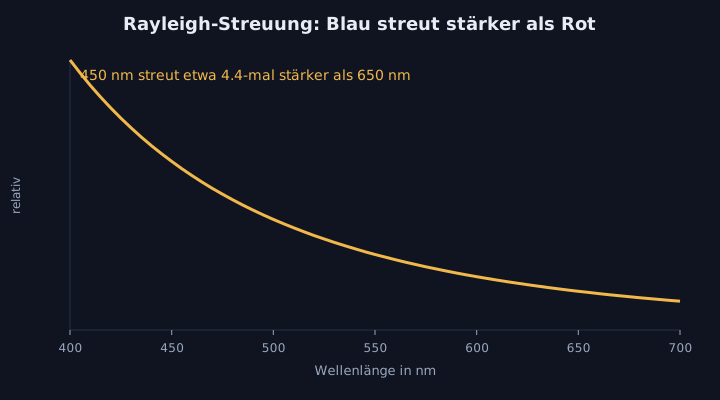
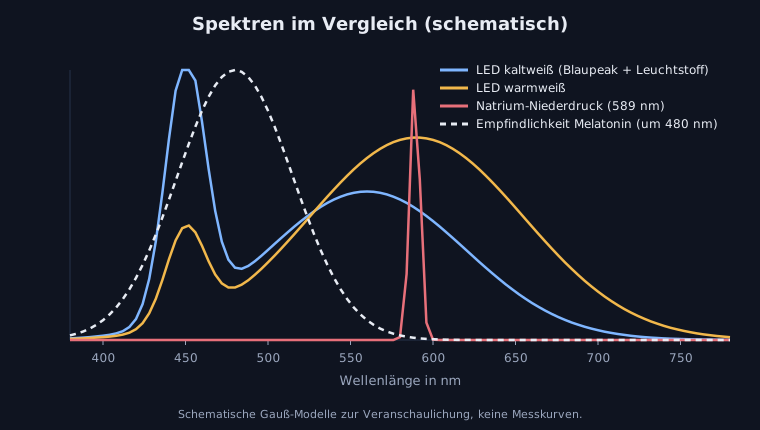
- Das Spektrum zählt. Weiße LED mit hohem Blauanteil lockt Insekten stärker an, wird in der Atmosphäre stärker gestreut (Blau etwa 4-mal so stark wie Rot) und wirkt stärker auf die Melatoninbildung des Menschen als warmes oder bernsteinfarbenes Licht.
- Tiere reagieren, aber nicht alle gleich. Gut belegt sind die Anlockung von Insekten, die Desorientierung ziehender Vögel und die Fehlleitung von Schildkrötenjungtieren. Bei Bestandsrückgängen ist Licht ein Faktor unter mehreren.
- Der Mensch reagiert über die innere Uhr. Abendliches und nächtliches Licht verschiebt den Schlafrhythmus. Gesundheitliche Langzeitfolgen wie das Krebsrisiko sind hinweisend, aber nicht abschließend belegt.
- Lösungen sind bekannt und wirtschaftlich. Nur beleuchten, wo und wann nötig, abschirmen, dimmen, warme Lichtfarbe wählen. Das spart Energie und Geld und ist mit Sicherheit vereinbar.
Hinweis: Die Inhalte sind ein Fachüberblick, keine Rechts-, Gesundheits- oder Planungsberatung.
Abbildungen / Figures
Fachbuch
„Künstliches Licht bei Nacht. Physik, Biologie, Gesundheit, Maßnahmen und Recht“ – acht Kapitel mit Glossar, Evidenzstufen und Literatur (rund 90 Quellen). Leseprobe (PDF) · Vollausgabe im Angebot. Frei: Fachpapier LED und Lichtverschmutzung (PDF, 4 Seiten).
EN · Light pollution – overview
Thomas Schüller · Syntagma Forschung · ORCID 0009-0003-9799-6747
What this is about
Where nights are bright, more changes than the view of the stars. Artificial light at night affects insects, birds, bats, waters and plants, and it interferes with the human body clock. This overview summarises the state of research in seven specialist papers and states where the evidence is strong and where it is not.
Key findings
- It is getting brighter. Over 80 % of the world's population live under light-polluted skies, over 99 % in Europe and the USA. The lit area of the Earth grows by roughly 2 % per year; citizen-science data indicate that sky brightness rises considerably faster.
- The spectrum matters. White LED light with a high blue share attracts more insects, is scattered more strongly in the atmosphere (blue about 4.3 times as strongly as red) and suppresses melatonin more than warm or amber light.
- Animals respond, but not all alike. Well documented: attraction of insects, disorientation of migrating birds, misdirection of sea turtle hatchlings. For population declines, light is one factor among several.
- Humans respond through the body clock. Evening and night-time light shifts the sleep rhythm. Long-term health effects such as cancer risk are indicated but not conclusively shown.
- Solutions are known and economical. Light only where and when needed, shield, dim, choose warm colour temperature (at most 3000 K; 2700 K or amber in sensitive areas). This saves energy and cost and is compatible with safety.
Measuring
Satellite sensors (VIIRS-DNB) are barely sensitive below about 500 nm and see mainly upward-directed light, so they underestimate the contribution of blue-rich LED. Ground meters (Sky Quality Meter) and citizen-science observations complement them.
Note: This is a specialist overview, not legal, medical or planning advice. Sources were compiled from expert knowledge without a web search; citations must be verified against the originals before publication.