An Open-Source Workbench Pipeline for Non-Invasive BMI Mechatronics
An Open-Source Workbench Pipeline for Non-Invasive BMI Mechatronics
From Brain Signal Detection to Servo Command: SENSACT × CORTEX ONE as a Modular Development Environment
Author: Thomas Schüller · Syntagma Forschung · Vienna Contact: forschung@tschueller.com · ORCID 0009-0003-9799-6747 Affiliation: Independent, no institutional affiliation, privately funded Version: v0.1.1 (Preprint) · Date: 2026-09-01 · First release 2026-05-17 License: CC BY 4.0 (documentation) · MIT (code)
Abstract
Brain-Machine-Interface (BMI) research suffers from a reproducibility gap between the classification pipeline (EEG acquisition, feature extraction, model training) and the actuation pipeline (mechatronic hand, servo control, force control). Most available frameworks address either one or the other; integrated workbenches are commercial and proprietary. This work documents an open-source pair of 60 functioning engineering tools (SENSACT for mechatronics, CORTEX ONE for BMI), available as browser-based React artifacts and coupled via a BLE protocol. It is argued that such modular workbenches lower the threshold for reproducible BMI prosthesis development — not through new algorithms, but through consolidation of established methods in a verifiable form.
Keywords: Brain-Machine-Interface · Mechatronics · Open Source Hardware · Prosthetics · Reproducibility · EEG Classification · Forward Kinematics
1. Introduction
1.1 Problem Statement
The development of BMI-controlled prostheses requires the integration of at least three disciplines: neurophysiology (EEG acquisition, artifact cleaning), machine learning (classification of neural patterns), and mechatronics (actuator design, force control, sensor fusion). In academic literature, these strands are typically treated separately. Common pipelines exist — Brain Computer Interface 2000 (BCI2000), OpenViBE, BrainFlow — but they focus on the BMI part; the actuator side remains either a black box (proprietary prosthesis APIs) or requires separate software stacks (ROS2, MoveIt, GraspIt!).
This separation has practical consequences for reproducibility: a study reporting “BMI-controlled grasping with 87% success rate” can rarely be documented in a way that another lab could replicate it without considerable implementation effort (Pasley et al. 2012; Kübler 2020).
1.2 Contribution of This Work
A workbench pair is presented in two single-file React artifacts:
- CORTEX ONE (37 tabs, 2126 lines) — BMI development platform with P300 speller demo, SSVEP classification, AutoML wizard, code generator, filter designer, hardware specs (ADS1299, 4–32 channels, BLE 5.0)
- SENSACT (23 tools, 855 lines) — Mechatronics workshop with Forward Kinematics hand designer, grip physics simulator, PID tuner with step response visualization, drivetrain calculator, stress analysis, code generator (ESP32 C++, OpenSCAD, Python ROS2), BLE protocol designer, QC test protocol, assembly instructions
Both artifacts are usable independently but couple via a documented BLE packet format:
EEG signal → CSP+LDA classification → BLE packet(0xAA, type=0x01,
   grip_id, force, speed, servos[5], chk) → PCA9685 PWM → servo movement
The contribution is not algorithmic — all methods used are known from the literature — but methodological: the bundling in a verifiable, browser-based form that runs without backend, without cloud dependency, and without API keys.
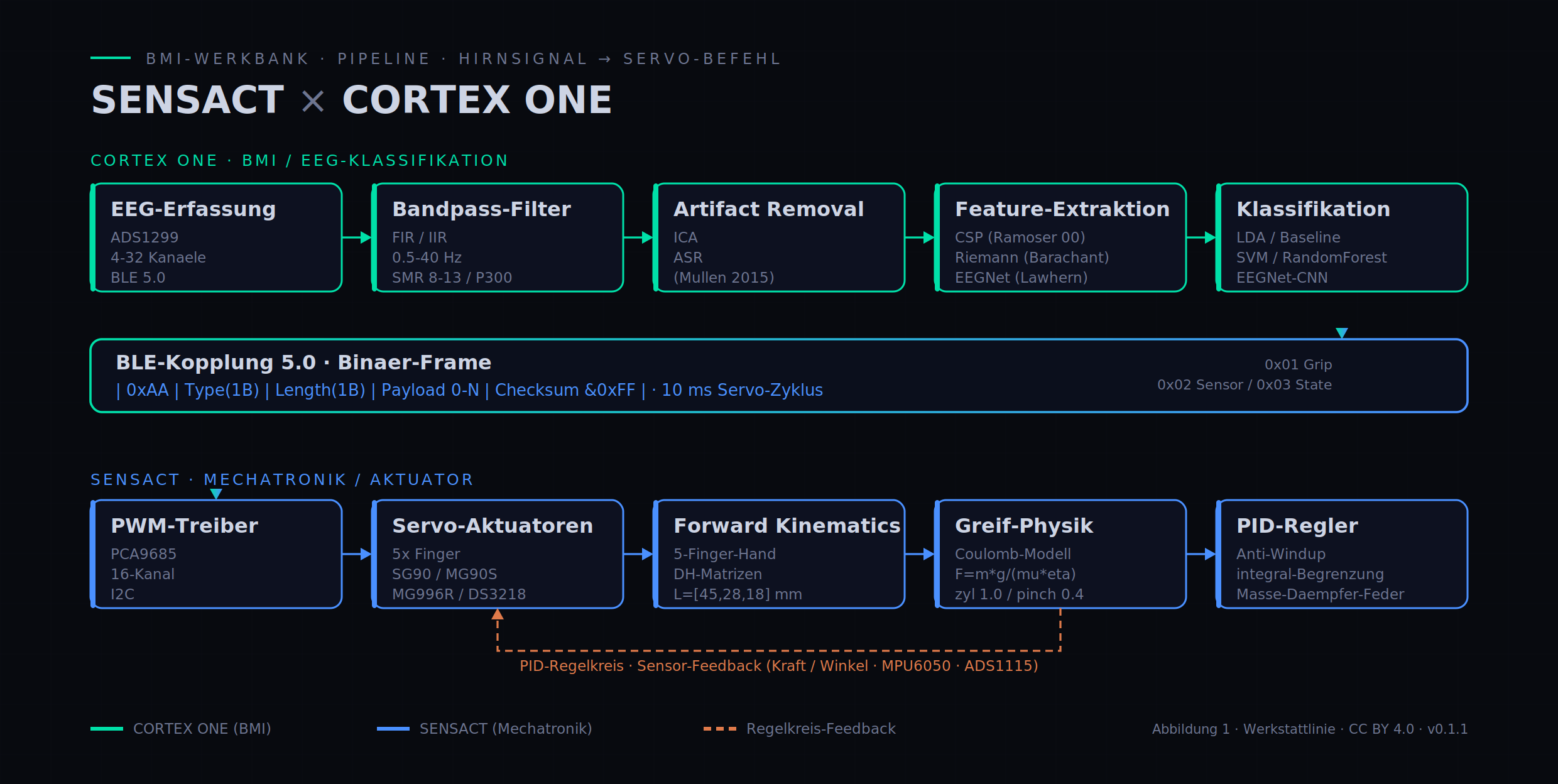
Figure 1 — The end-to-end BMI-workbench pipeline from EEG acquisition (CORTEX ONE) through the documented BLE coupling to servo actuation and grip physics (SENSACT), including the PID control loop with sensor feedback. Both workbenches are usable independently; the figure shows the coupled constellation as a whole.
2. Methodology
2.1 EEG Pipeline (CORTEX ONE)
EEG classification follows the established pipeline schema:
- Bandpass filter (FIR/IIR, configurable): 0.5–40 Hz for general BMI applications, 8–13 Hz for SMR (Sensorimotor Rhythm), 1–30 Hz for P300
- Artifact removal: ICA or ASR (Artifact Subspace Reconstruction; Mullen et al. 2015)
- Feature extraction: Common Spatial Patterns (CSP; Ramoser et al. 2000) for motor imagery, Riemannian Geometry (Barachant et al. 2012) for more robust classification, EEGNet (Lawhern et al. 2018) for end-to-end deep learning
- Classification: Linear Discriminant Analysis (LDA) as baseline, SVM/Random Forest for comparison, EEGNet-CNN for comparison
The pipeline is parameterizable in the AutoML wizard; the code generator produces corresponding Python scripts (Scikit-learn, PyTorch).
2.2 Mechatronics Pipeline (SENSACT)
The actuator side implements classical Forward Kinematics for a 5-finger hand with thumb opposition:
with as Denavit-Hartenberg transformation matrices and segment lengths mm per finger (typical anthropometric values; NASA-STD-3000 Vol. I).
Grip physics use the Coulomb friction model:
with as friction coefficient (object-specific) and as the efficiency of the grip type (cylindrical=1.0, pinch=0.4, tripod=0.5).
For servo sizing, the standard equation applies:
The recommendations implemented in the tool are based on servo datasheets (SG90, MG90S, MG996R, DS3218; source: TowerPro datasheets and independent measurements).
2.3 PID Controller
The PID tuner uses standard PID with anti-windup:
with limited to . The step response is simulated on a mass-damper-spring model:
with disturbance as a step function for robustness testing. Three plant models are available: finger grip force, wrist rotation, linear actuator.
2.4 BLE Protocol
The coupling protocol between CORTEX ONE and SENSACT follows a minimal binary format:
| Header (0xAA) | Type (1B) | Length (1B) | Payload (0–N) | Checksum (1B) |Type codes: 0x01 = Grip Command, 0x02 = Sensor Data, 0x03 = State Change. Checksum is a simple 8-bit sum modulo (sum & 0xFF). Deliberately no CRC-16/32 — sufficient for the targeted latency (10 ms servo cycle) and limited address space (1 receiver).
3. Reproducibility and Limitations
3.1 What is Reproducible
- Code: Both artifacts are single-file React components, without build step, without backend, without external API calls (except Google Fonts CDN for typography). MIT licensed, embeddable in any React project
- Hardware specs: ESP32-S3 + ADS1299 (BMI) and PCA9685 + ADS1115 + MPU6050 (mechatronics) are commercially available (Mouser, DigiKey) for total costs under 200 €
- 3D models: The OpenSCAD code generator produces parametrically scalable hand models (40–200% size factor), printable on standard FDM (PETG, TPU) and SLA (resin)
- Calculations: All formulas are visible in the code, all constants documented
3.2 What is Not Claimed
- No clinical validation. These workbenches are development tools, not medical devices. An MDR classification (probably Class I or IIa for the prosthesis) is intended for a later point
- No comparative performance studies against commercial BMI systems
- No patient data in the tools — all “live data” in the demos is generated/simulated
3.3 Known Weaknesses
- EEG simulation in CORTEX ONE: Live data in the demo is synthetic (sine components + noise), not real EEG recordings. For real application, ADS1299 hardware connection is required
- Grip physics in SENSACT: Simplified Coulomb model without rolling friction, without compliant contact, without tactile feedback loop
- PID model: Assumed linear, no friction-stiction, no nonlinearities of servo gearing
- No multi-user synchronization: BLE 5.0 theoretically supports multiple clients, not implemented in the tool
4. Discussion
4.1 Workbenches vs. Black-Box APIs
The trend in the BMI industry is toward integrated but proprietary solutions (Neuralink, Synchron, Blackrock Cereplex). These are clinically validated but difficult to access for independent research. Open-source alternatives (OpenBCI, Muse SDK) offer access to the EEG layer but leave the actuator side open.
The workbench logic presented here closes this gap not through a new SDK but through making the pipeline visible in browser-based tools that invite inspection, modification, and verification. This is epistemically closer to Pearl’s “Book of Why” idea (Pearl & Mackenzie 2018) than to classical algorithm publication: the focus is not innovation but verifiability of the constellation.
4.2 Interfaces
- OpenBCI/BrainFlow: Direct connection possible; CORTEX ONE filter tab can accept BrainFlow streams (TODO: hardware bridge)
- ROS2: Code generator produces rclpy nodes that can be integrated into existing ROS2 stacks
- MoveIt: Forward Kinematics from SENSACT exportable as URDF (TODO: URDF generator)
- Clinical studies: With dedicated use as a pure research tool (not for patient treatment), MDR does not apply; for clinical application Class I registration with BfArM/BASG required
4.3 Ethics
These workbenches are explicitly developed for civilian, prosthetic, and assistive applications. Use in military or weapons contexts is not excluded by the license (MIT permits any use), but is not desired by the author’s declared stance (Helbing 2019; Müller 2020 on the autonomous weapons debate).
5. Conclusion
The SENSACT × CORTEX ONE workbench pipeline closes a concrete gap in open-source BMI prosthetics development: it makes the entire chain from brain signal detection to servo command visible and verifiable in two browser-based artifacts. The scientific novelty does not lie in the algorithms used — these are established — but in the consolidated, reproducibly documented form. For the reproducibility crisis in applied neurotechnology (Chen et al. 2020; Vidaurre et al. 2020), this form is useful: not because it proposes a new paradigm but because it provides the existing paradigm in a verifiable, modifiable form.
Follow-up work should document the hardware connection to ADS1299, prepare a first clinical pilot study with shoulder disarticulation patients (Class I MDR), and publish the integration with OpenBCI/BrainFlow as a formal bridge specification.
Closure
Closure type: USE-CASE CLOSURE — The scope of this working paper is fixed (pipeline documentation for BMI×mechatronics workbench). Extension only via fork or follow-up paper. Hardware connection and clinical validation are explicitly outside this paper and subject to future work.
References
- Barachant, A., Bonnet, S., Congedo, M., & Jutten, C. (2012). Multiclass Brain-Computer Interface Classification by Riemannian Geometry. IEEE Trans. Biomedical Engineering, 59(4), 920–928. doi:10.1109/TBME.2011.2172210
- Chen, X., et al. (2020). The reproducibility crisis in EEG research and possible solutions. NeuroImage, 220, 117119.
- Helbing, D. (2019). Towards Digital Enlightenment. Springer. ISBN 978-3-319-90869-8
- Kübler, A. (2020). The history of BCI: From a vision for the future to real support for personhood in people with locked-in syndrome. Neuroethics, 13, 163–180.
- Lawhern, V. J., et al. (2018). EEGNet: a compact convolutional neural network for EEG-based brain–computer interfaces. J. Neural Engineering, 15(5), 056013.
- Mullen, T. R., et al. (2015). Real-time neuroimaging and cognitive monitoring using wearable dry EEG. IEEE Trans. Biomedical Engineering, 62(11), 2553–2567.
- Müller, V. C. (2020). Ethics of Artificial Intelligence and Robotics. In Stanford Encyclopedia of Philosophy. URL: plato.stanford.edu/entries/ethics-ai
- Pasley, B. N., et al. (2012). Reconstructing speech from human auditory cortex. PLoS Biology, 10(1), e1001251.
- Pearl, J., & Mackenzie, D. (2018). The Book of Why: The New Science of Cause and Effect. Basic Books. ISBN 978-0465097609
- Ramoser, H., Müller-Gerking, J., & Pfurtscheller, G. (2000). Optimal spatial filtering of single trial EEG during imagined hand movement. IEEE Trans. Rehabilitation Engineering, 8(4), 441–446.
- Vidaurre, C., et al. (2020). Sensorimotor functional connectivity: a neurophysiological factor related to BCI performance. Frontiers in Neuroscience, 14, 575081.
Code and Data Availability
- SENSACT:
sensact.jsx(124 KB, 855 lines, 23 tools), MIT - CORTEX ONE:
cortex-one-dark.jsx(154 KB, 2126 lines, 37 tabs), MIT - Bundle:
bmi-werkbank_v0.1_2026-05-17.zipwith all materials
Author: Thomas Schüller · Syntagma Forschung · Vienna · forschung@tschueller.com · ORCID 0009-0003-9799-6747 Affiliation: Independent, no institutional affiliation, privately funded License: CC BY 4.0 (documentation) · MIT (code) Version: v0.1.1 (Preprint, Zenodo Threshold A) · Date: 2026-09-01 · First release 2026-05-17 Word count: ~1850 · Pages: ~7 (A4)