STATUS · Blueprint + reference implementation · work state v3.1 · bundle v3.8 · not in production
FIGURES · 100 % synthetic: 277 demo findings for method demonstration, no real awards, persons or statistics
PARTNER · one-person workshop · independent · privately funded · no institutional affiliation
DATE · 2026-09-23 · identifier FORSCH-PROV0445 (PROVISIONAL)
AUTHOR · Thomas Schüller · Syntagma Forschung · Vienna · ORCID 0009-0003-9799-6747 · forschung@tschueller.com
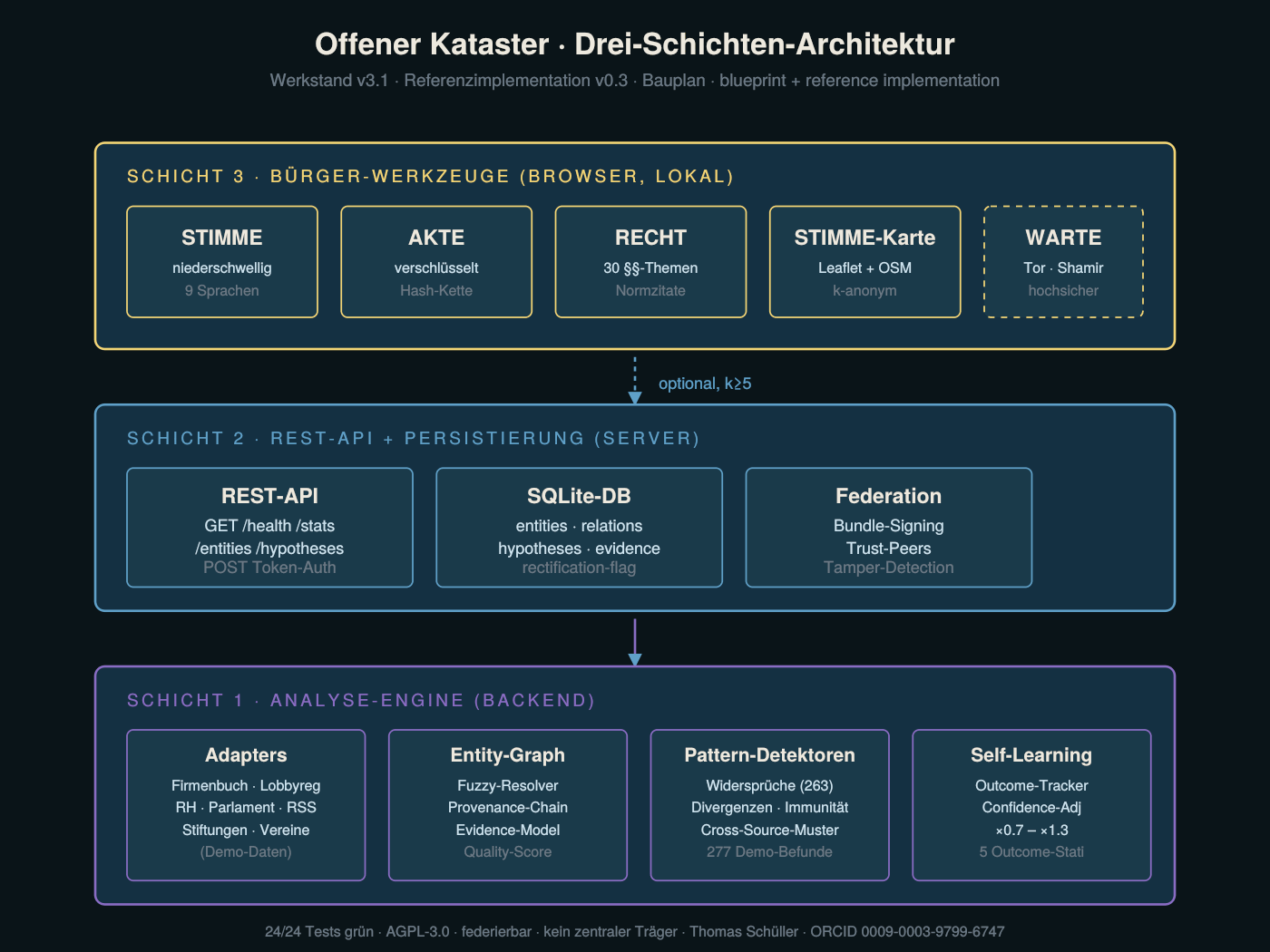
Figure 1: Three layers — citizen tools in the browser, REST API with persistence, analysis engine.
Offener Kataster (open register) is a blueprint with a runnable reference implementation for a federated transparency tool. It shows how public data can be processed into hypotheses with a complete source chain, and how affected people can document and represent themselves without handing data to a central operator.
The work grew out of work on administrative harassment: people facing authorities, institutions and controls without legal protection and without a voice. The Kataster is the technical answer — a voice tool for self-advocacy, not a tool for surveilling others.
bauplan-referenz| What it is | a methodological proposal plus runnable demo code that demonstrates it |
| What it is not | no production service, no investigative tool with real data, no operator platform |
| For whom | research networks, NGOs, newsrooms, technically skilled initiatives who want to run the concept under their own responsibility |
| Aim of publication | a citable, forkable reference state |
| Strand | Content | Scope | Archive |
|---|---|---|---|
| A · Backend | analysis engine: adapters, entity graph, pattern detectors, learning loop, REST API, federation, hosting guide | 21 modules · 24/24 tests green | …strang-A-backend…zip |
| B · Citizen tools | STIMME (9 languages), AKTE (Web Crypto), RECHT (30 legal topics with statute citations; links lead to the RIS home page, legal review pending), STIMME map, Evidentia, WARTE client, overview | 11 HTML files, no server | …strang-B-buergerwerkzeuge…zip |
| C · Manifestos | Civic Stack, architecture, Kataster manifesto, WARTE manifesto | each DE + EN | …strang-C-manifeste…zip |
| Finding type | Count |
|---|---|
| Contradictions (rule catalogue, 73 rules) | 263 |
| Divergences of supreme courts | 3 |
| Immunity patterns | 6 |
| Mortality anomalies | 1 |
| Cross-source patterns | 4 |
| Total | 277 |
All findings are produced from synthetic demo data. They demonstrate the method, not a state of affairs.
Whoever forks the Kataster keeps these rules or chooses a different name:
is_marked_disputed)The Kataster stands beside an independent work line on the same starting theme, administrative harassment. Both remain separate; they refer to each other but take over no modules from each other.
| Work | Identifier | Relation to the Kataster |
|---|---|---|
| BEISTANDSWERK — tool for understanding and documenting in nine legal areas | BEIST-0001 | sister tool; self-advocacy in the individual case, no server |
| Emergency card — printable A6 generator, ten languages | BEIST-0002 | sister tool for the first moment |
| Application paper “The legal-knowledge gap as an asymmetry of control” | FORSCH-PROV0442 | theoretical framing of the same problem |
Shared principle of both lines: a voice tool, not a tool for surveilling others.
Installation, start and operation of all strands are described in the
handbook (…handbuch…, DE + EN).
Code AGPL-3.0-or-later · texts, manifestos and graphics CC BY 4.0 · no warranty.