Work page · Syntagma Forschung
Antibiotic Resistance and Its Alternatives — Personalised instead of Standard Therapy
Companion dossier to the work FORSCH-0211 "The Body as a Biotope System" Status: 2026-06-17 · research synthesis, fully cited · CC BY 4.0 · Thomas Schüller · ORCID 0009-0003-9799-6747
Reading note: This is a research-based overview dossier, not medical advice. Sources are listed at the end and referenced in the text as [n]. Where the evidence is uncertain, this is stated explicitly.
0 · Why this dossier connects to the biotope work
FORSCH-0211 describes the body, for the control and supply question, as a system of nested milieus — "fields of condition instead of responsibilities" — with the point that the microbiome is foreign life within the body's boundaries and that a milieu can tip into another stable state (§4.1, §8.1). This is the natural frame for the antibiotic question: a broad-spectrum antibiotic is an intervention not into "an organ" but into a field of condition (the gut milieu), which may lose its order and tip (dysbiosis). The alternatives — phages, narrow spectrum, personalised therapy — are the attempt to act gently on the milieu rather than across the board. This dossier works up the state of the science.
1 · The problem in numbers
Antimicrobial resistance (AMR) is one of the greatest global health threats. The most comprehensive estimate to date (GRAM project, The Lancet 2022) puts the 2019 toll at 1.27 million deaths directly attributable to bacterial AMR and 4.95 million deaths associated with AMR [1]. Six pathogens — E. coli, S. aureus, K. pneumoniae, S. pneumoniae, A. baumannii, P. aeruginosa — accounted for 929,000 of the attributable deaths [1]. A follow-up analysis (1990–2021, with projection to 2050) confirms the rising trend [2].
The WHO Bacterial Priority Pathogens List 2024 (BPPL) groups 15 pathogen families into "critical / high / medium". The critical group contains carbapenem-resistant Acinetobacter baumannii (CRAB), carbapenem-resistant Enterobacterales (CRE) and third-generation-cephalosporin-resistant Enterobacterales; carbapenem-resistant K. pneumoniae tops the ranking, while carbapenem-resistant P. aeruginosa was downgraded from "critical" to "high" [3][4]. The acronym ESKAPE (Enterococcus faecium, Staphylococcus aureus, Klebsiella pneumoniae, Acinetobacter baumannii, Pseudomonas aeruginosa, Enterobacter) bundles the clinically most dangerous multidrug-resistant germs.
2 · Biochemistry and genetics of resistance — and the evolution behind it
2.1 How antibiotics act
Antibiotics attack a few conserved bacterial targets: cell-wall synthesis (β-lactams such as penicillins/cephalosporins/carbapenems inhibit peptidoglycan cross-linking; glycopeptides like vancomycin bind D-Ala-D-Ala), protein synthesis at the ribosome (aminoglycosides, tetracyclines, macrolides, oxazolidinones), DNA replication (fluoroquinolones inhibit DNA gyrase/topoisomerase IV), folate synthesis (sulfonamides, trimethoprim) and the cell membrane (polymyxins such as colistin) [general knowledge; cf. 3].
2.2 How resistance arises (mechanisms)
Four basic strategies:
- Enzymatic inactivation — β-lactamases cleave β-lactams; especially critical are ESBLs (extended-spectrum β-lactamases) and carbapenemases (KPC, NDM-1, OXA-48), which render almost all β-lactams ineffective [3].
- Efflux pumps — active export of the drug (e.g. MexAB-OprM / MexXY in P. aeruginosa); often multidrug pumps [9].
- Target modification/protection — alteration of the binding site (e.g. mecA/PBP2a in MRSA; gyrase mutations against quinolones; ribosomal methylation against macrolides).
- Reduced permeability — loss/modification of porins (e.g. OmpK36 in Klebsiella).
2.3 Genetics: mutation, selection, horizontal gene transfer
Resistance arises through spontaneous mutation + selection (the antibiotic kills the susceptible, the resistant multiply) and — crucially — through horizontal gene transfer (HGT): conjugation (plasmids), transformation (free DNA) and transduction (via phages). Mobile genetic elements — plasmids, transposons, integrons — bundle resistance genes and spread them between species. The totality of all resistance genes in a community is the resistome; soils and waters are its natural reservoirs [7][8].
2.4 Evolution and adaptation under selection pressure
Resistance often carries a fitness cost (resistant strains grow more slowly without the antibiotic), which compensatory mutations then offset — after which resistance no longer disappears on its own even without further antibiotic pressure. One must distinguish resistance (heritable growth despite the drug) from tolerance/persistence (temporary survival without genetic resistance, e.g. in "persister" cells). Important for therapy strategy: collateral sensitivity — resistance to one drug can increase susceptibility to another; this can be exploited deliberately (see §4.3) [13][14].
Biotope link: Selection happens not "in the bacterium" but in the milieu — antibiotic concentration, pH, nutrients and neighbouring microbes form the field of condition that decides which variant prevails.
3 · Broad-spectrum antibiotics: pharmacology and side effects
3.1 Pharmacology (PK/PD)
Efficacy depends on pharmacokinetics (absorption, distribution, tissue penetration, excretion) and pharmacodynamics. One distinguishes time-dependent killers (β-lactams: time above the MIC matters) from concentration-dependent ones (aminoglycosides, fluoroquinolones: peak or AUC/MIC). This logic is exactly the balance-across-the-boundary logic from FORSCH-0211 §5.1: the effect closes where the conditions of the target milieu (concentration, binding) permit.
3.2 Collateral damage to the microbiome (dysbiosis)
Broad-spectrum antibiotics hit not only the pathogen but the whole gut flora. The result is dysbiosis with loss of colonization resistance — the healthy flora's ability to repel pathogens via nutrient and space competition, short-chain fatty acids (e.g. butyrate), bile-acid metabolism, bacteriocins and immune modulation [5][6]. A shift toward Proteobacteria is typical [6]. This is the tipping of FORSCH-0211 §8.1 in the empirical record: a field of condition passes into another, less protected state.
3.3 Clostridioides difficile infection (CDI)
The clearest clinical example: after antibiotics, C. difficile can expand into the emptied niche — severe colitis. Higher microbial diversity = higher colonization resistance [5]. 20–35 % of patients suffer recurrence after standard therapy (vancomycin/metronidazole) [6] — the reason microbiome restoration (FMT, §5.5) works here.
3.4 Class-specific adverse effects
- Fluoroquinolones (ciprofloxacin etc.): FDA and EMA warn of disabling, potentially permanent damage to tendons, muscles, joints, nerves and the CNS; tendon rupture (esp. Achilles) can occur within 48 h; increased risk of aortic aneurysm/dissection. The EMA has restricted use and withdrawn some older quinolones; the FDA advises against use in uncomplicated infections (sinusitis, bronchitis, uncomplicated UTI) when alternatives exist [10][11].
- Aminoglycosides: oto- and nephrotoxicity. Macrolides: QT prolongation. β-lactams: allergy, CDI risk. Tetracyclines: photosensitivity, tooth discoloration in children.
Core point: the broader the spectrum, the greater the collateral damage to the inner milieu — the pharmacological case for narrow spectrum and personalisation (§6).
4 · Phage therapy
4.1 What phages are
Bacteriophages are viruses that infect only bacteria — the most abundant biological entities on Earth. Two life cycles: lytic (the phage replicates and bursts the cell — therapeutically desired) and lysogenic (phage DNA integrates into the bacterial genome and rests — undesired, since genes, including resistance/toxin genes, can be transferred). Therapy uses strictly lytic phages. Advantages: high specificity (usually species/strain-precise, spares the rest of the flora), self-amplification at the site of infection, action on biofilms, few side effects [15][16].
4.2 Coevolution and phage resistance
Bacteria defend against phages via receptor modification (the phage no longer docks), restriction-modification systems, CRISPR-Cas (bacterial "immunity" against phage DNA) and abortive-infection systems [review 17]. Phages and bacteria thus coevolve — phage resistance is the rule, not the exception. Countermeasure: phage cocktails (several phages with different receptors) and combination with antibiotics.
4.3 Phage steering and collateral sensitivity (an evolutionary trick)
Especially elegant: one chooses phages whose receptor is a resistance factor. Classic example ΦOMKO1 (Chan et al., Yale): the phage uses the efflux pump MexAB/MexXY-OprM of P. aeruginosa as its docking site. If the bacterium becomes phage-resistant, it shrinks this pump — and thereby becomes antibiotic-susceptible again. This trade-off is stable over ~70 bacterial generations, even under combined phage and antibiotic pressure [13][14]. This is "steering evolution" — driving the bacterium into a corner where every escape is costly.
4.4 Clinical evidence
The trigger of modern interest was the Tom Patterson case (2016): a life-threatening carbapenem-resistant A. baumannii infection was successfully treated with a personalised phage cocktail (Texas A&M, US Navy) under an FDA compassionate-use authorisation; Steffanie Strathdee publicised the case and founded the IPATH centre (UC San Diego) [18]. A systematic cohort of 20 patients with drug-resistant mycobacteria showed phage therapy is safe and well tolerated and can produce clinically meaningful improvement [18]. Caveat (important): the evidence so far is mostly case reports and small series, not large randomised trials; several controlled trials are underway. Efficacy is therefore promising but not yet proven at RCT scale [16][18].
4.5 Regulatory status and limits
Phages fit poorly into the classic approval frame (a defined, unchanging molecule): they are biological, self-amplify, and often need to be personalised and updated. In Belgium a pragmatic route exists via magistral preparation (pharmacy-individual compounding); the Eliava Institute (Georgia) has treated with phages for nearly a century. In the EU/USA, compassionate-use single cases and trials dominate [15][16]. Limits: narrow host range (precise pathogen diagnostics required), phage resistance, immune response to phages, manufacturing and purity standards.
5 · Further approaches beyond classical antibiotics
5.1 Endolysins / enzybiotics
Endolysins are phage-encoded enzymes that cut the bacterial cell wall (peptidoglycan) from outside — especially effective against Gram-positive pathogens (exposed peptidoglycan). Advantages: rapid bactericidal action, low resistance development, biofilm activity. Against Gram-negative germs the outer membrane is a barrier; engineering tricks (fusion with membrane-penetrating peptides) help [19][20].
5.2 Antimicrobial peptides (AMPs)
Short (15–150 aa) peptides that mostly disrupt the bacterial membrane — broad spectrum, fast action, low resistance tendency; some are endogenous (part of innate immunity). Challenges: stability, toxicity, cost [19][20].
5.3 CRISPR-Cas as a "programmable" antibiotic
CRISPR-Cas can be repurposed to specifically cut resistance or virulence genes or to selectively kill only resistant bacteria — e.g. via phages as the vehicle. Still mostly preclinical; the delivery problem is unsolved [17].
5.4 Anti-virulence, anti-biofilm, antibodies, vaccines
- Anti-virulence: do not kill, but "disarm" (block toxins, quorum sensing, adhesins) → lower selection pressure.
- Anti-biofilm: break up biofilms, in which bacteria are up to 1000× more tolerant.
- Monoclonal antibodies against toxins/surfaces.
- Vaccines: prevention directly lowers antibiotic need — modelling studies show vaccination could avert a substantial share of the AMR burden [cf. 1].
5.5 Microbiome restoration: probiotics and FMT
Faecal microbiota transplantation (FMT) restores colonization resistance in recurrent CDI. Since 2022/2023 the first standardised FMT products are FDA-approved in the USA: REBYOTA (Ferring, rectal) and VOWST (Seres, oral) to prevent recurrent CDI [21][22]. In one analysis, success (no recurrence over 8 weeks) was 70.6 % for REBYOTA vs. 57.5 % for placebo [21]. Direct biotope link: therapy as re-erecting a tipped milieu, not as another broad blow.
6 · Personalised instead of standard therapy
6.1 The principle
Instead of an empirical broad-spectrum "shotgun", a precise, narrow-spectrum, pathogen-exact therapy — guided where possible by rapid diagnostics. This spares the milieu (§3) and reduces resistance selection.
6.2 Diagnostics as bottleneck and lever
- Rapid phenotypic susceptibility testing (rapid AST): over 90 technologies in development that deliver an antibiogram faster than the classic overnight culture [23].
- Metagenomic sequencing (mNGS): hypothesis-free pathogen and resistance-gene detection straight from the sample; enables early de-escalation of broad-spectrum antibiotics in over 30 % of cases without worse outcome [23]. But: the genotype–phenotype gap is real — for many pathogen-drug pairs the actual susceptibility cannot yet be inferred reliably enough from the resistance gene for individual therapy [23]. Diagnostics does not yet replace the phenotypic antibiogram everywhere.
- Personalised phage cocktails (§4.4) and microbiome-based approaches (§5.5) are personalised therapy in the strictest sense.
6.3 Biotope connection
FORSCH-0211 supplies the rationale: each patient is an individual inner milieu (own microbiome, own fields of condition). A "standard antibiotic" treats an average that does not exist; "individual therapy" treats the actual milieu — and keeps it below the tipping threshold (§8.1 model: condition-dependent rates, hysteresis).
7 · Artificial intelligence: opportunities and dangers
7.1 Opportunities
- Drug discovery: a deep-learning model (Stokes, Collins, Barzilay et al., Cell 2020) identified halicin — a structurally novel antibiotic with broad activity (incl. M. tuberculosis, carbapenem-resistant Enterobacterales, C. difficile, pan-resistant A. baumannii in mouse models) [24]. In 2023 the same group used AI to find abaucin, targeted against A. baumannii (acting via disrupted lipoprotein trafficking) [25].
- Phage–host matching, resistance prediction, diagnostic support: ML models on mNGS data accelerate AST estimation [23].
- Stewardship: AI can support prescribing decisions and de-escalation.
7.2 Dangers
- Dual use / biosecurity: Urbina et al. (Nature Machine Intelligence 2022) showed that a simple sign-flip in a molecule generator's reward term (rewarding toxicity instead of penalising it) generated ~40,000 toxic molecules in under 6 hours — including the nerve agent VX and other known chemical-warfare agents [26]. The same technology that finds remedies can design poisons.
- Reliability: AI predictions from genotype data inherit the genotype–phenotype gap (§6.2) — misclassification can lead to under-/over-treatment.
- Bias and data: models are only as good as their (often Western/clinically skewed) training data.
- Access equity & governance: AI diagnostics/drugs risk widening the gap between rich and poor health systems; dual-use research is still inadequately covered by regulation [26].
AI takeaway: large acceleration potential, but no substitute for phenotypic confirmation, and a serious dual-use risk that demands active governance.
8 · One Health: factory farming, water, environment
AMR is not a purely clinical problem. The One Health approach links humans, animals and the environment:
- Factory farming & aquaculture are now major contributors to the global resistome [7][8]. A substantial fraction of administered antibiotics is excreted unmetabolised and reaches soils and waters with manure.
- Volumes: estimates put ~3,000–27,000 tonnes of animal drugs and bioactive intermediates released into the environment annually [7].
- Water/wastewater: treatment plants (municipal and hospital) are hotspots for the proliferation of resistant bacteria and the exchange of resistance genes; ARGs are found in sludge, river water, sediment, air and soil [7][8]. Soil is the primary natural reservoir of resistance genes.
- Transmission routes animal–human–environment are documented; AMR circulates in both clinical and natural environments [8].
- Regulation: the EU banned growth-promoting antibiotics in 2006; since 2022 stricter rules apply (ban on routine prophylaxis, reservation of critical antibiotics for humans). Prevention rather than end-of-pipe remediation delivers the most durable reductions [7].
Biotope link: the environment is itself a biotope system of coupled milieus; the resistome flows across boundaries (barn → manure → soil → water → human) — exactly the "chain of milieus with filtered transitions" of FORSCH-0211 §4, here on the ecological level.
9 · Synthesis — what this means for the biotope work
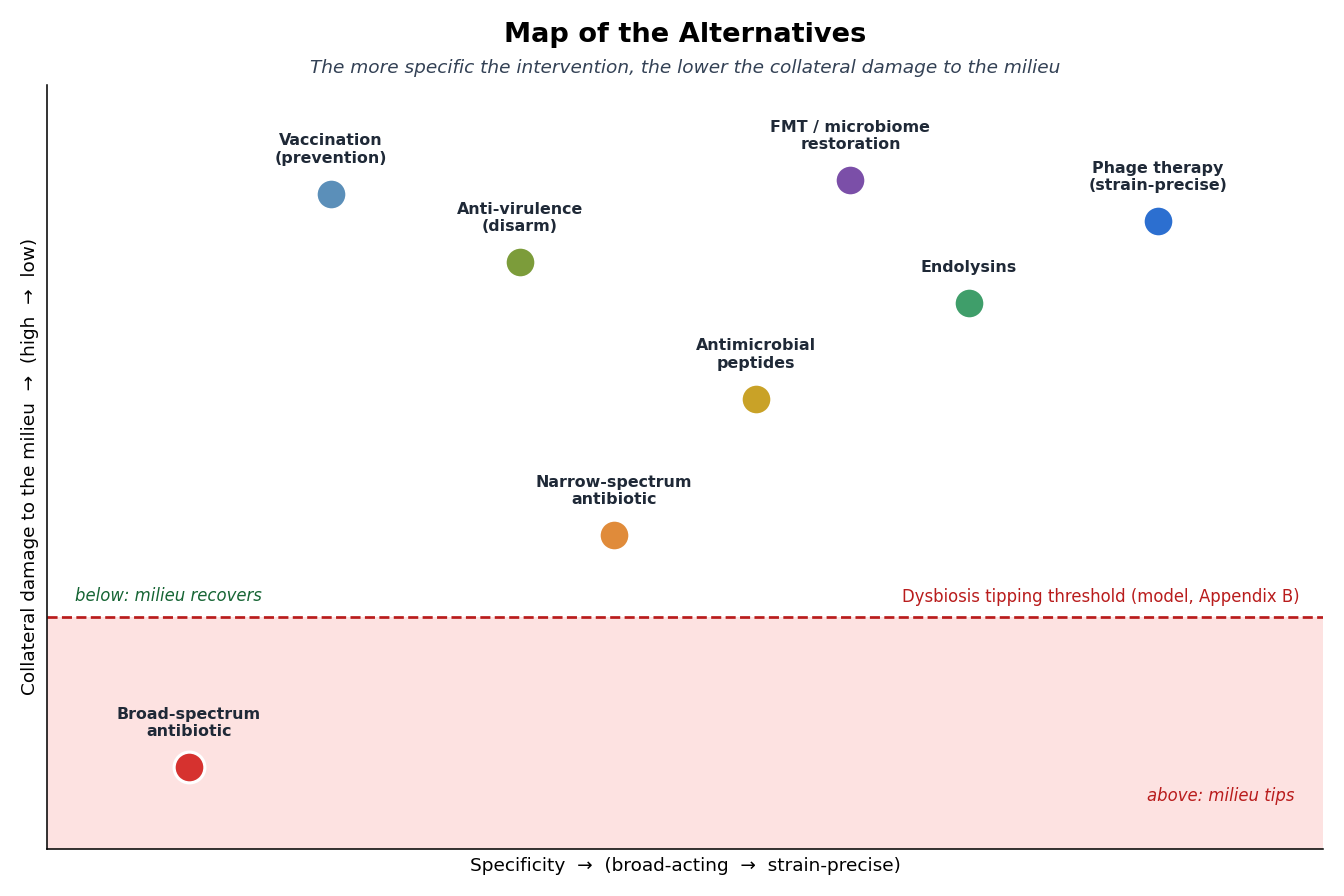
- Antibiotics are milieu interventions, not organ interventions. Their main harm (dysbiosis, CDI) is a tipping of a field of condition — the empirics of FORSCH-0211 §8.1.
- Broad spectrum = broad milieu damage; narrow spectrum/personalisation = milieu-sparing. Pharmacology (§3) gives the rationale for personalised therapy (§6).
- The alternatives are all "milieu-oriented": phages (strain-precise), endolysins/AMPs (targeted), FMT (re-erect the milieu), diagnostics (hit the actual milieu).
- Evolution can be steered (phage steering, collateral sensitivity) — therapy as intervention into the field of condition of selection, not as a command to "the bacterium".
- AI accelerates but does not replace the phenotypic antibiogram, and brings a dual-use risk.
- One Health shows: the biotope does not end at the skin — the resistome circulates through coupled environmental milieus.
Open / uncertain (honestly flagged): phage-therapy evidence still mostly case-based; mNGS genotype→phenotype not yet therapy-grade for all pairs; many alternatives (CRISPR-antibacterial, many AMPs/endolysins against Gram-negatives) preclinical; environmental volume figures span a wide range.
Appendix A · Minimal model of collateral sensitivity (phage steering)
To make the trade-off of §4.3 visible, a minimal, dimensionless population model (pure NumPy, no biological fit). A trait axis e ∈ [0,1] denotes the efflux-pump level: high e = antibiotic-resistant (pump removes the drug) but phage-susceptible (the phage uses the pump as receptor); low e = phage-resistant but antibiotic-susceptible. Death rates: d_AB(e)=A·(1−e) (antibiotic kills low-efflux), d_phage(e)=P·e (phage kills high-efflux); a small growth/pump-cost term; weak mutational diffusion over the e grid.
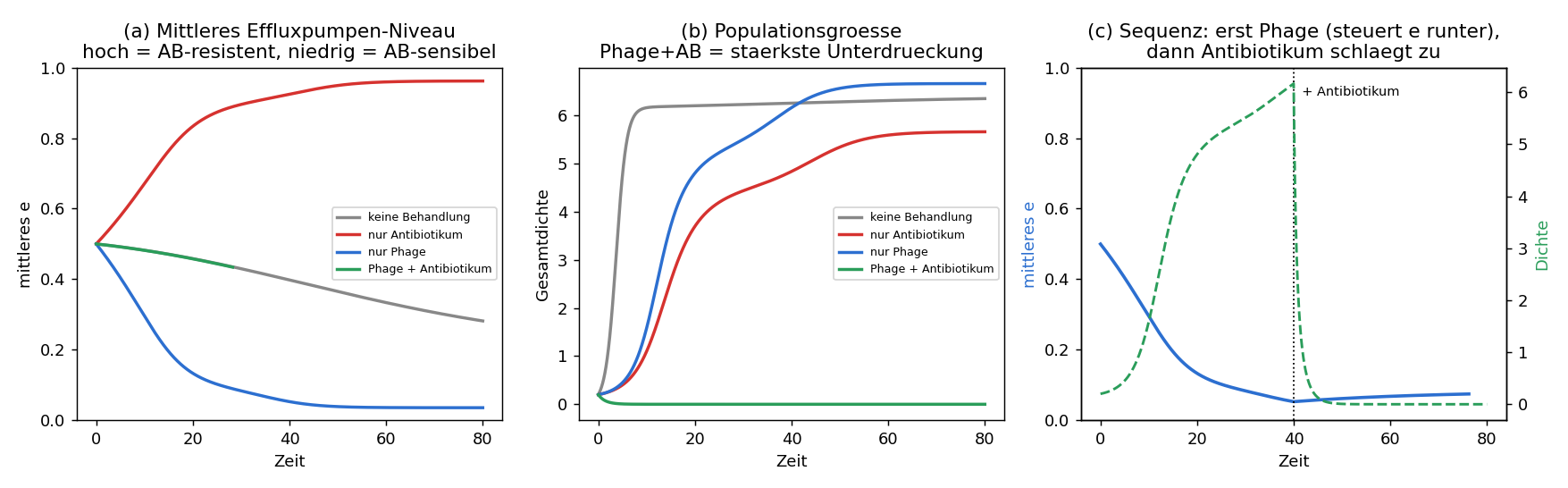
Result: antibiotic alone selects high efflux (e*≈0.96, resistant, survives); phage alone selects low efflux (e*≈0.04), rendering the population antibiotic-susceptible again; phage + antibiotic clamps the population from both ends → density → 0. The sequence "phage first, then antibiotic" shows the same: the phage steers the bacterium into a susceptible state in which the antibiotic bites again. This is the model illustration of phage steering (ΦOMKO1, §4.3) — and biotope logic: therapy acts on the field of condition of selection, not as a command to "the bacterium". Reproducible: models/phage_steering_model.py. Caveat (B14): shows that the trade-off is real as a dynamic — no claim about the concrete parameters of a real pathogen.
Appendix B · PK/PD model of microbiome collateral damage
A second minimal model (pure NumPy) couples the antibiotic's pharmacokinetics (daily dose over 7 days, elimination at rate ke) to a microbiome model of commensals Bc and a pathogen Bp (e.g. C. difficile) with colonization resistance (term −α·Bc·Bp: the commensals suppress the pathogen). The antibiotic kills commensals at rate kc (= spectrum breadth: high = broad-spectrum) and barely touches the pathogen (kp small — the pathogen is largely resistant to the drug).
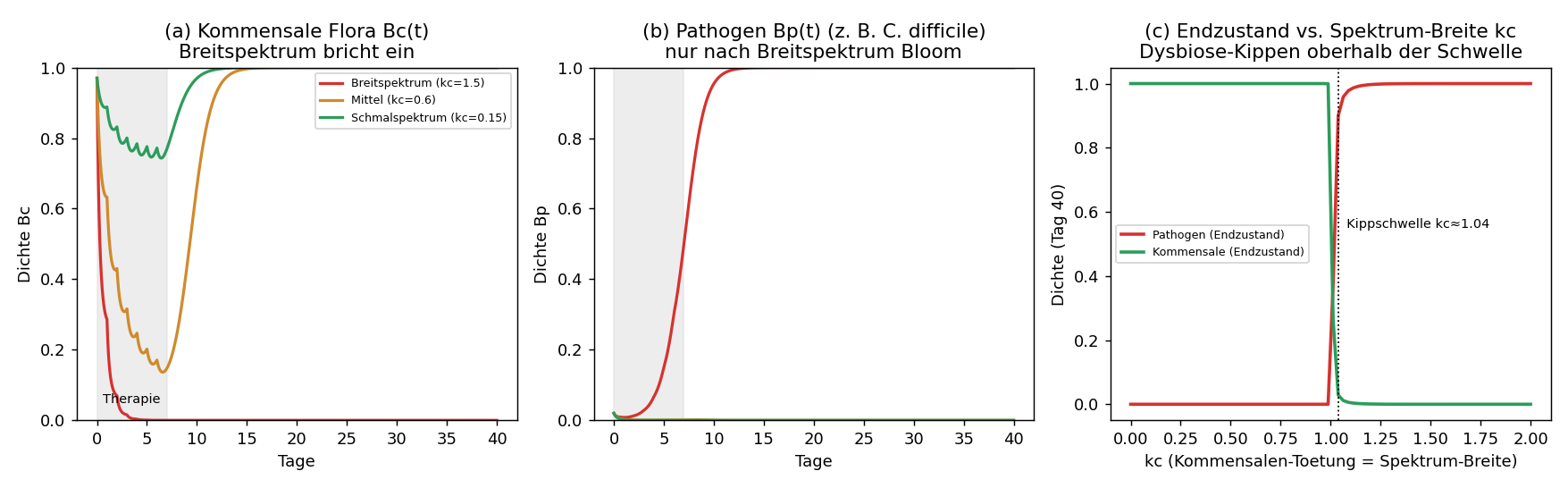
Result (day 40): narrow and medium spectrum → commensals recover (Bc≈1.0), pathogen stays low (Bp≈0). Broad spectrum → commensals to 0, pathogen to 1.0 — the milieu tips into the dysbiotic state and does not recover on its own. Panel (c) shows a sharp threshold at kc≈1.04: only above this spectrum breadth does the system tip. This is exactly the tipping/hysteresis logic of FORSCH-0211 §8.1, here pharmacological: broad spectrum crosses the gut milieu's tipping threshold, narrow spectrum stays below it — the quantitative case for personalised, milieu-sparing therapy (§6). Reproducible: models/pkpd_microbiome_model.py. Caveat (B14): minimal illustration, not a clinical fit.
Appendix C · One-Health resistome chain model (barn → water → human)
A third minimal model (pure NumPy): the spread of antibiotic resistance genes (ARGs) along a chain of coupled environmental milieus — barn → manure → soil → water → human — with filtered transitions (transfer coefficient k<1 per boundary) and per-compartment decay. The barn carries the source S (antibiotic use → selection). This is FORSCH-0211 §4 at the ecological level: "a movement through a chain of milieus, filtered at each boundary".
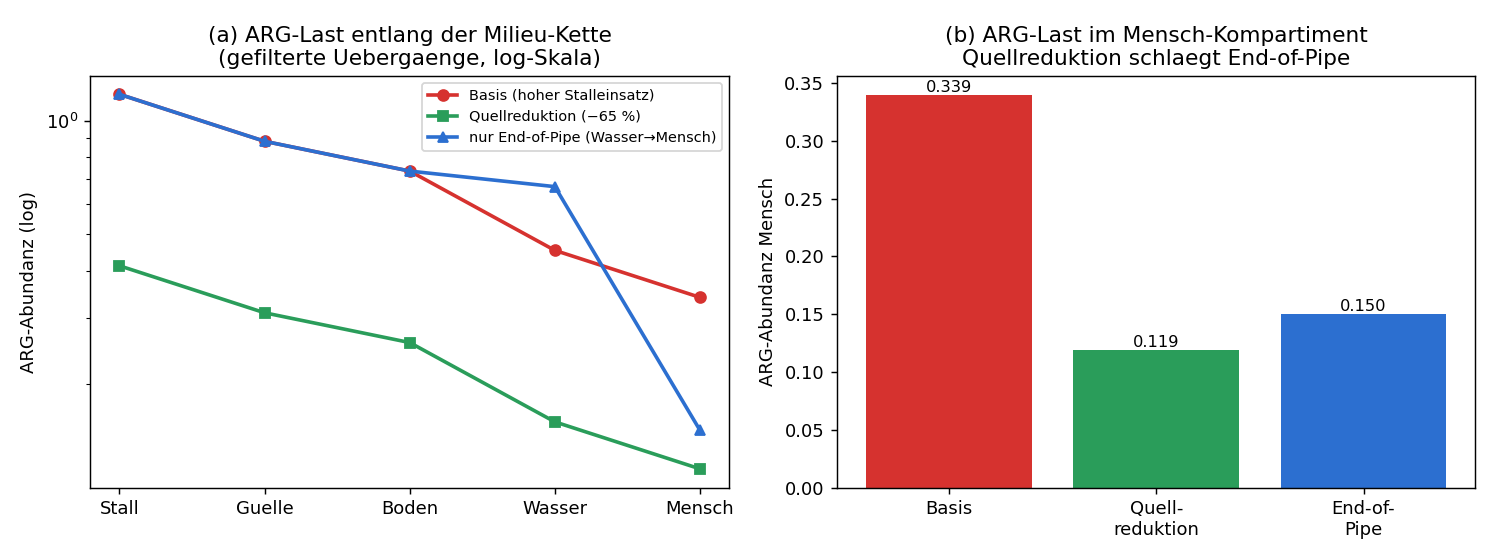
Result: relative to baseline, source reduction (e.g. the EU ban on growth-promoting antibiotics, −65 % barn use) lowers the human-compartment ARG load by ~65 %; a pure end-of-pipe measure (improving only the water→human transition, e.g. better wastewater treatment) achieves only ~56 % and leaves the entire upstream chain (barn, manure, soil, water) unchanged. This is the model form of the §8 statement: prevention at the source beats end-of-pipe remediation [7]. And it is biotope logic: the boundaries order the flow, but the most effective lever is the source, not the last filter. Reproducible: models/resistome_chain_model.py. Caveat (B14): minimal illustration, no calibrated environmental parameters.
Sources
(Identical numbering to the German version.)
- Murray CJL et al. (GRAM) (2022). Global burden of bacterial antimicrobial resistance in 2019: a systematic analysis. The Lancet 399(10325):629–655. https://www.thelancet.com/journals/lancet/article/PIIS0140-6736(21)02724-0/fulltext · PMC: https://www.ncbi.nlm.nih.gov/pmc/articles/PMC8841637/
- GBD AMR Collaborators (2024). Global burden of bacterial antimicrobial resistance 1990–2021, forecasts to 2050. The Lancet. https://www.thelancet.com/journals/lancet/article/PIIS0140-6736(24)01867-1/fulltext
- WHO (2024). WHO Bacterial Priority Pathogens List, 2024. https://www.who.int/publications/i/item/9789240093461 · https://www.who.int/news/item/17-05-2024-who-updates-list-of-drug-resistant-bacteria-most-threatening-to-human-health
- WHO BPPL 2024 analysis, Lancet Infect Dis (2025). https://pmc.ncbi.nlm.nih.gov/articles/PMC12367593/
- Colonization Resistance of the Gut Microbiota against Clostridium difficile. PMC4790290. https://www.ncbi.nlm.nih.gov/pmc/articles/PMC4790290/
- Seekatz AM, Safdar N, Khanna S (2022). The role of the gut microbiome in colonization resistance and recurrent CDI. Therap Adv Gastroenterol. https://www.ncbi.nlm.nih.gov/pmc/articles/PMC9679343/
- Antibiotic Use in Livestock and Environmental Antibiotic Resistance: A Narrative Review. PMC12304651. https://pmc.ncbi.nlm.nih.gov/articles/PMC12304651/
- Antibiotic resistance in livestock, environment and humans: One Health perspective. PMC11016740. https://pmc.ncbi.nlm.nih.gov/articles/PMC11016740/
- Phage steering of antibiotic-resistance evolution in P. aeruginosa. Evol Med Public Health 2020. https://academic.oup.com/emph/article/2020/1/148/5870287
- FDA (2018). Drug Safety Communication — fluoroquinolone warnings. https://www.fda.gov/drugs/drug-safety-and-availability/fda-drug-safety-communication-fda-updates-warnings-oral-and-injectable-fluoroquinolone-antibiotics
- EMA (2019). Disabling and potentially permanent side effects lead to suspension or restrictions of quinolone and fluoroquinolone antibiotics. https://www.ema.europa.eu/en/news/disabling-potentially-permanent-side-effects-lead-suspension-or-restrictions-quinolone-fluoroquinolone-antibiotics
- Overview of Side-Effects of Antibacterial Fluoroquinolones. PMC10056716. https://pmc.ncbi.nlm.nih.gov/articles/PMC10056716/
- Phage Resistance Evolution Induces the Sensitivity of Specific Antibiotics in P. aeruginosa PAO1. PMC9603957. https://www.ncbi.nlm.nih.gov/pmc/articles/PMC9603957/
- Fitness Trade-Offs between Phage and Antibiotic Sensitivity in Phage-Resistant Variants. PMC10650657. https://pmc.ncbi.nlm.nih.gov/articles/PMC10650657/
- Bacteriophage Therapy: Discovery, Development, and FDA Approval Pathways. Pharmaceuticals 2025; PMC12389134. https://pmc.ncbi.nlm.nih.gov/articles/PMC12389134/
- Phage therapy: From biological mechanisms to future directions. Cell 2023. https://www.sciencedirect.com/science/article/pii/S0092867422014611
- Phage to ESKAPE: Personalizing Therapy for MDR Infections — A Comprehensive Clinical Review. PMC12566643. https://www.ncbi.nlm.nih.gov/pmc/articles/PMC12566643/
- Phage Therapy of Mycobacterium Infections: Compassionate Use in 20 Patients. PMC9825826. https://www.ncbi.nlm.nih.gov/pmc/articles/PMC9825826/ · IEEE Pulse (IPATH/Strathdee): https://www.embs.org/pulse/articles/battling-superbugs-how-phage-therapy-went-from-obscure-to-promising/
- Endolysins: a new antimicrobial agent against AMR … Front. Pharmacol. 2024; PMC11144922. https://pmc.ncbi.nlm.nih.gov/articles/PMC11144922/
- Endolysins and membrane-active peptides: engineering against gram-negative bacteria. Front. Microbiol. 2025. https://www.frontiersin.org/journals/microbiology/articles/10.3389/fmicb.2025.1603380/full
- Efficacy of Fecal Microbiota (REBYOTA) in Recurrent CDI: Systematic Review and Meta-Analysis. PMC11116275. https://www.ncbi.nlm.nih.gov/pmc/articles/PMC11116275/
- CIDRAP. FDA approves fecal microbiota product for recurrent C difficile. https://www.cidrap.umn.edu/antimicrobial-stewardship/fda-approves-fecal-microbiota-product-recurrent-c-difficile
- Next-generation rapid phenotypic antimicrobial susceptibility testing. Nat Commun 2024; PMC11550857. https://pmc.ncbi.nlm.nih.gov/articles/PMC11550857/ · mNGS/stewardship: PMC12384723 https://pmc.ncbi.nlm.nih.gov/articles/PMC12384723/
- Stokes JM et al. (2020). A Deep Learning Approach to Antibiotic Discovery (halicin). Cell 180(4):688–702. https://www.cell.com/cell/fulltext/S0092-8674(20)30102-1 · https://news.mit.edu/2020/artificial-intelligence-identifies-new-antibiotic-0220
- Liu G et al. (2023). AI discovery of abaucin against A. baumannii. MIT News: https://news.mit.edu/2023/using-ai-scientists-combat-drug-resistant-infections-0525
- Urbina F et al. (2022). Dual use of artificial-intelligence-powered drug discovery. Nature Machine Intelligence 4:189–191. https://www.nature.com/articles/s42256-022-00465-9 · https://pubmed.ncbi.nlm.nih.gov/36270472/
Dossier created 2026-06-17 as companion material to FORSCH-0211. Research-based, balanced (opportunities and dangers), uncertainties flagged. Not medical advice. CC BY 4.0 · Thomas Schüller · ORCID 0009-0003-9799-6747 · forschung@tschueller.com