The Body as a Biotope System (FORSCH-0211, v1.4)
The Body as a Biotope System
Milieu, Boundary, and the Discipline of a Mode of Description
Work ID: FORSCH-0211 (assigned 2026-06-10 after register double-check; formerly 0117 / PENDING) Work type: Framework work (cross-organ), level of description Version: v1.4 (full version, bilingual DE/EN; conceptual diagram of the milieu chain added) Methodology: WERKSTATTLINIE v2.0 Date: 2026-06-18
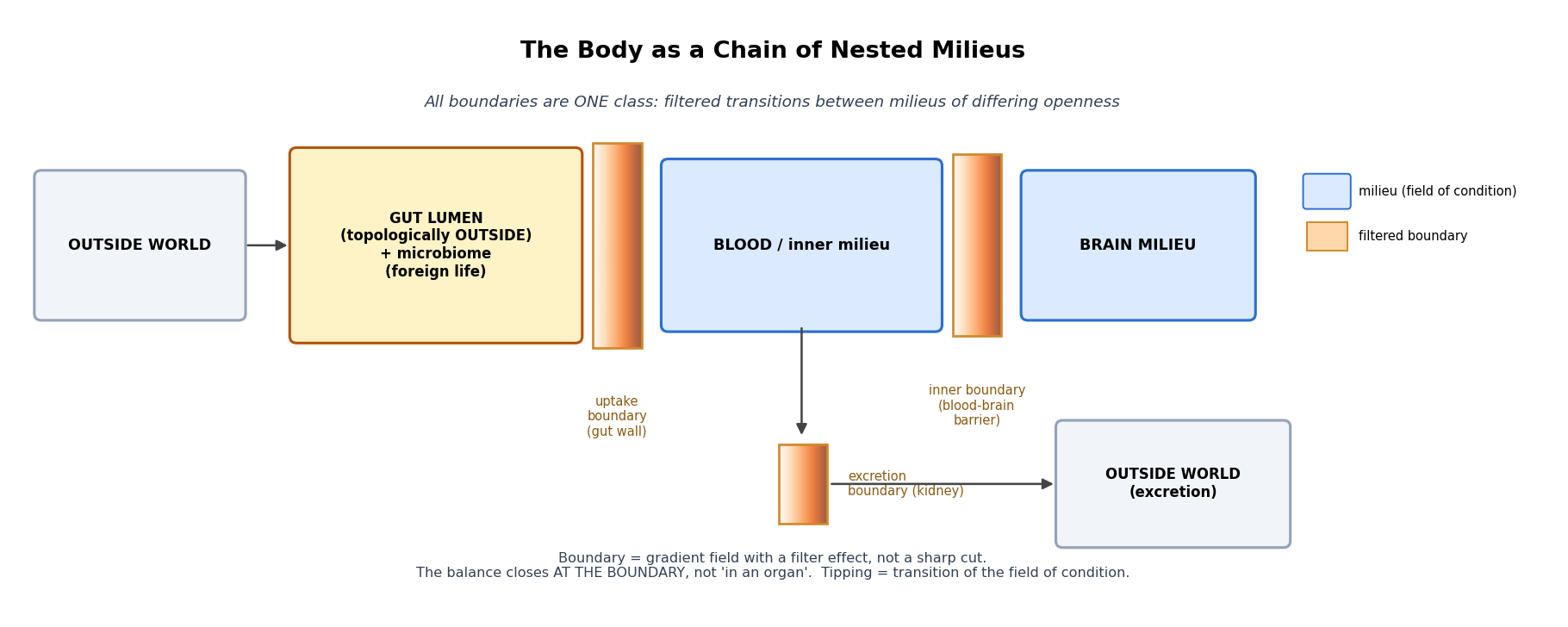
Changes vs. v1.3: A conceptual diagram (Fig. 1, §4) added: the chain of nested milieus with filtered boundaries — outside world → gut lumen (topologically outside, with the microbiome) → uptake boundary → blood → blood-brain barrier → brain, plus the excretion boundary. It makes the core claim (all boundaries are one class; the balance closes at the boundary) visible at a glance. No substantive claim changed.
Changes vs. v1.2: §8.1 is no longer an open test but an executed one. A minimal coupled-milieu model (Appendix A) confirms the criterion: with constant transfer rates the system has one stable state (collapses to pharmacokinetics); with condition-dependent rates it shows a bistable window and hysteresis — i.e. tipping that no constant-rate model reproduces. §8 and §7 are updated to report this result. (v1.2 changes — circularity criterion in §3, placement/transferability in §4.1, decidable §8 criterion, second Canguilhem support in §2 — are retained.)
v1.1 (2026-06-11) and v1.2 (2026-06-16) remain version-closed as prior full versions. v1.3 supersedes them as the upload candidate; it executes the §8.1 test and reports the result, no prior claim is withdrawn.
0 · Position of the work
This work lifts a thought out of FORSCH-0111 §5b and sets it on its own footing. In 0111 the biotope view served as a compact frame for a bounded question: how a psychoactive substance is supplied, distributed, and converted at its site of action in the body. The thought carries further than that single question. It concerns how substance action and control in the body are described at all, and therefore a choice of mode of description that precedes the matter itself.
FORSCH-0111 §5b remains version-closed as the seed. This work cites it and builds beyond it: it grounds the thought conceptually (Canguilhem’s concept of milieu), tests it against the biological literature (the gut as an incompletely mixed bioreactor), and bounds it against its own overstatement (the holobiont ontology debate). It also connects to the parallel strand “transport as noise under constraint,” which runs the same textbook critique on the molecular and cellular levels.
1 · The proposal and its question-form
Instead of describing the body as a collection of organs — the liver does X, the brain does Y, the gut does Z — it is viewed as a system of nested milieus. Each organ, each compartment is a milieu with its own conditions. The milieus are nested and coupled. The system is open to the outside at defined boundaries.
The shift sits not in the object but in the question-form. Organ language suggests responsibilities, as if each organ had a task it discharges, like a department in a firm. This question-form looks for an owner of an effect: “Which organ controls X?” has the same construction as “Whose process is this?”. The milieu or biotope view asks differently. It asks not who is responsible, but which conditions obtain where, and how they pass into one another. This is the work’s guiding formula: fields of condition instead of responsibilities.
The point is not stylistic. The two question-forms lead to different answers and make different things visible. Asking after responsibility finds an organ and ends at a name. Asking after conditions finds a milieu and ends at a relation.
2 · Conceptual foundation: the milieu (Canguilhem)
The term “milieu” is not chosen arbitrarily. Georges Canguilhem framed it for biology and medicine in a way that carries exactly the double structure needed here. For Canguilhem the milieu denotes the surroundings of a living being, but at the same time — in the literal sense of mi-lieu, the mid-place — the centre of those surroundings. The living being lives in the middle of its surroundings. Canguilhem’s framing is shaped by Jakob von Uexküll’s concept of the Umwelt: the meaning-laden segment of the surroundings specific to each living being. Decisive for this work is the extension Canguilhem makes: the same relation holds inward. The organism is the milieu in which tissues and organs are situated; the relation between organism and environment is the same as that between the parts and the whole of an organism.
This symmetry is the conceptual backbone of the present work. It permits treating outer and inner boundaries as the same type of relation without conflating the levels. The symmetry rests centrally on this one passage; it does not, however, hang on a single sentence. It is corroborated by Canguilhem’s normativity thread (The Normal and the Pathological), where the inward relation of organism and parts reappears as the capacity of a living being to be normal within its milieu. So the backbone has a second point of support: a living being is normal in a given milieu insofar as it is the morphological and functional solution that life has found in response to the demands of that milieu. Normality is not a statistical constant but a capacity to adapt to a changing milieu. This links the biotope view to the question of health and tipping (§5): a milieu that passes into another stable state changes the conditions under which its inhabitants can be normal.
From Canguilhem a line runs to Foucault, who develops the political concept of milieu out of Canguilhem’s reading of Lamarck and Newton and takes it up for the theory of security and population (lectures “Security, Territory, Population,” 1977–1978). That line is already developed in the border-regime cluster (FORSCH-0119 ff.); it is marked here as a node, not unfolded again. What matters is the consistency: the same concept of milieu carries from the cell through the organism to social regulation without reducing one level to another.
3 · Why the biotope view holds for the control and supply question
The biotope view structurally avoids the responsibility error and makes the relational nature of the processes visible. Four observations from FORSCH-0111 support this in the concrete case.
First: a substance “pool” is not an organ but a milieu. Separate milieus — say the gut compartment and the brain compartment of the serotonin economy — are separated by a selectively permeable boundary, not by an organ boundary in the anatomical sense.
Second: a controlling organ does not issue commands like a commander but, as a milieu, sets conditions. The liver does not “control” the serotonin and tryptophan economy by instruction but by setting albumin, glucose, and the tryptophan ratio — conditions that other milieus encounter and respond to.
Third: an effect closes its balance where the conditions of a milieu permit, not “in an organ.” This is the balance logic from FORSCH-0111 §5a: the chemical balance does not always close at the active substance but, under circumstances, at the enzyme or transporter — that is, at a condition of the milieu.
Fourth: the tipping from reversible to irreversible is a milieu phenomenon. A milieu passes into another stable state, the way a lake tips over. This connects with Canguilhem’s notion of normality: the tipping is not the defect of an organ but the transition of a field of condition into a state in which the prior normativity no longer holds.
A note against circularity. To say the balance closes “where the conditions of a milieu permit” would be empty if a milieu were identified only by where the balance closes. It is not. A milieu is delimited in advance and independently, by a measurable threshold in the gradient field: a steep change in a physicochemical variable (oxygen, pH, osmolarity) or a permeability boundary that selects what may cross. The boundary is fixed by these thresholds first; only then is it asked where the balance closes. The claim “the balance closes at a condition of the milieu” is therefore testable against an independently drawn boundary, not self-confirming.
4 · First axis: the inner boundary as the same kind of thing
The boundaries considered in the supply case are not each special cases but instances of one class: transitions between milieus of differing openness. Three types appear. Uptake boundaries — mouth, lung, gut wall, skin — let the outside world in under control. Excretion boundaries lead out under control. Inner boundaries, such as the blood-brain barrier, separate two inner milieus from one another.
These boundaries are of the same kind: filtered, selective transitions. From this follows a reordering of a substance’s movement through the body. It is not a passage through a homogeneous interior but a movement through a chain of milieus, filtered and re-set at each boundary. This reading agrees with the parallel strand “transport as noise under constraint,” which shows that textbook depictions often draw sharp boundaries and directed arrows where only emergent statistics obtain. The biotope boundary is not a sharp cut but a gradient with a filter effect.
4.1 · Anchor point A1 executed: the topology of openness
The sharpest part of the first axis is topological. The gut lumen is not “inside.” It is topologically the outside world — a tube that traverses the body. What lies in the gut lumen has not yet been taken up; it is on the outer side of a continuous interface running from mouth to anus. Uptake is the crossing from this topological outside into an inner milieu. This topology is not itself a new finding — that the alimentary canal is a tube traversing the body is textbook. What the work adds is the placement: the gut boundary is filed under the single class of filtered milieu-transitions (§4), not treated as a special case.
The biological literature supports and refines this point, with the pertinent spatial findings coming from mouse models and therefore to be read as model-based. The separation between gut lumen and the wall-adjacent zone is understood not as a stacking of sharply separate compartments but — for the colon of the gnotobiotic mouse — as an incompletely mixed bioreactor: lumen and wall-adjacent region are mixed at micrometre scales, with distinct spatial distributions of individual taxa (Welch et al., PNAS 2017, in a 15-species model community). The boundary is therefore real and functional — it controls which bacteria can approach the epithelium — but it is a gradient field, not a cut. Physicochemical gradients (oxygen, pH, short-chain fatty acids such as butyrate) govern colonization; in the murine cecum the compartmentalization between lumen and crypts is lost under physiological stress — surgery together with preoperative fasting and antibiotics (Zaborin et al., mSystems 2020). This is biotope logic in the empirical record: fields of condition with gradients, whose tipping changes the order. Because these spatial findings are murine, their transfer to the human gut is itself a hypothesis, not an established fact; they are used here as a model-level illustration of biotope logic, not as direct human evidence.
A second topological point: the microbiome is foreign life within the chain. In the gut — topologically outside, yet within the body’s boundaries — lives a foreign population whose metabolism intervenes in the host’s conditions. The body is not even biologically purely “one.” This sharpens the first axis: the boundaries order not only material flows but also the habitats of different inhabitants.
5 · Second axis: selective openness to the outside
A biotope is by definition open to the outside. It has material and energy flows across its boundaries; otherwise it would be no living space but a dead box. The body is open in this precise sense: at the uptake boundaries, at the excretion boundaries, and via the gut lumen as topological outside.
This openness is selective and filtered. It consists in controlled transitions at defined boundaries, not in a merging with the environment. It is precisely the filter function that makes the boundaries the interesting object. The statement “the body is open to the outside” is therefore precise and not esoteric, provided one reads it materially and topologically: defined gates, filtered transitions, controlled balances.
5.1 · Anchor point A2 executed: the balance across the boundaries
Read across organs, a continuous balance structure emerges. Each inner milieu keeps a balance across its boundaries: what comes in, what goes out, what is converted. The liver balances nutrients and metabolites against the blood milieu; the kidney balances water, electrolytes, and excretion products against the outside; the lung balances gases. These balances are coupled — the output condition of one milieu is the input condition of the next.
The cross-organ point is that none of these balances is closed “in the organ.” It closes at the boundary, in relation to the adjacent milieu. This is the generalization of the balance logic from FORSCH-0111 §5a beyond the psychedelics question: wherever a substance is converted in the body, the locus of the balance is not an owner-organ but a boundary between fields of condition.
6 · The methodological limit [B14]: framework, not ontology
Here lies the point at which the work must be secured against its own temptation. The biotope view is a mode of description, a framework — not an ontology. It complements the organ view; it does not refute it. Organs are real. A surgical intervention needs the organ view; an understanding of supply, distribution, and control needs the biotope view. They are two levels, and for the question treated here the biotope level is the more load-bearing, not generally “the more correct.”
This distinction is the B14 discipline: it is not claimed that the body is a biotope system instead of an organism, but that the biotope view shows more for the modulation and supply question. The temptation to jump from the view to an ontology is real and documented in science. The holobiont and hologenome debate is the pertinent example. The concept frames host plus microbiome as a functional unit; a strong reading elevates this unit to a unit of selection, a superorganism. Precisely this strong reading is controversial: critics object that it rests on overly restrictive assumptions and misses the actual complexity of selection in host-microbiome communities, and that selection at the level of the symbiotic community should not be the null hypothesis (Douglas & Werren, “Holes in the Hologenome,” mBio 2016; in the same direction Moran & Sloan, “The hologenome concept — helpful or hollow?”, PLOS Biology 2015). Even defenders of the holobiont concept stress that holobionts are not organ systems and not superorganisms, since those terms presuppose the genome of only one organism (Bordenstein & Theis, PLOS Biology 2015).
For this work a double caution follows. First: the biotope view is fruitful as a framework without the ontological claim that the body “really is” an ecosystem. It does not claim biology has overlooked something; it chooses a level of description that shows more for a particular question-form. Second: openness to the outside is meant materially and topologically, not as merging or unity with the environment. Both cautions are the same discipline that appears in the strand “transport as noise under constraint” as level discipline: do not smuggle an analogy across a boundary without declaring it. The biotope view sits on the cellular-compartmental level; it must not tip into the genetic-evolutionary level, where the holobiont ontology raises its contested claims.
7 · Yield
The yield of the work is a mode of description with three retained sentences. First: for the control and supply question the body can be described as a system of nested milieus — fields of condition instead of responsibilities. Second: inner and outer boundaries are the same type of relation, filtered transitions between milieus of differing openness; the movement of a substance is a balance across a chain of such boundaries. Third: this view is a framework, not an ontology; its limit is the B14 discipline and level separation, evidenced by the holobiont controversy. A fourth, added in v1.3: where the boundary rates are condition-dependent, the coupled balance can tip (Appendix A) — a behaviour the constant-rate, organ-additive reading cannot represent; this is the precise point at which the biotope description is more than a redescription.
The contribution beyond the existing literature lies not in a new biological finding — compartment topology, the milieu concept, and the holobiont debate are established. It lies in the linkage: transferring Canguilhem’s inside/outside symmetry of the milieu to the supply and balance question, treating all body boundaries as one class, and explicitly securing this mode of description against the ontological overstatement documented in the holobiont debate.
8 · Open points
Three points remain open for a later version, each to be treated after a literature check. v1.2 sharpens the first two from open questions into decidable tests.
First, a quantitative formulation of the coupled balances across several milieus. A viable approach is a compartment model: each milieu is a compartment with a state variable (concentration), the boundaries are transitions with transfer rates, and the coupled system is a set of balance equations in which the output of one compartment appears as the input of the next. Pharmacokinetics already uses such multi-compartment models. The open question — whether the biotope reading adds anything beyond their descriptive content — can be made decidable rather than left to assertion. The criterion: if the transfer rates are constant and the system is linear, the biotope reading collapses into standard pharmacokinetics and adds nothing formal. It earns its keep precisely where the rates are condition-dependent — set by the state of the adjacent milieu (albumin, pH, a transporter’s saturation) — so that the coupled system is non-linear and can tip between stable states (§3, fourth point). In that regime the locus of balance sits at the boundary, not in the compartment interior, and the tipping is a system property no constant-rate compartment model captures. This test has now been executed (Appendix A). A minimal coupled model with state-dependent rates exhibits a bistable window and hysteresis — a tip up at the upper fold and a tip down at a lower one — while the constant-rate limit has a single stable state for every supply value. The biotope reading therefore earns its keep in the non-linear regime and, honestly, reduces to pharmacokinetics in the linear one. The distinction is decidable, and here decided: it is not a redescription wherever the boundary rates depend on the milieu’s own state.
Second, the relation between the milieu/biotope language used here and the established concept of the ecological niche (Hutchinson: the niche as an n-dimensional hyperspace of conditions for existence). Both capture “fields of condition,” but the niche is referred to a population or species, the milieu to a living being or compartment. This is deliberately framed as a bounded test, not a programme: the default remains the level separation of §6. The test is whether the inner boundary (axis 1) can be read as a transition between niches in one concrete case without transferring the population reference of the niche to a compartment. If it cannot be done without that transfer, the niche language is set aside here. The burden of proof lies with the analogy, not against the level separation — otherwise exactly the level-blurring that §6 warns against threatens.
Third, a test case outside pharmacokinetics as a stress test of the generalization. Immune defense at an interface appears suitable: the mucosa is a field of condition (mucus layers, antimicrobial peptides, secretory IgA, pH) that regulates the approach of microbes without discharging it as “the task of an organ.” Here one could test whether the relation-instead-of-owner question-form also holds where it is not a substance being distributed but a population being controlled at a boundary.
Appendix A · §8.1 model — executed test
A minimal, dimensionless coupled-milieu model tests whether the biotope reading adds anything beyond a constant-rate compartment (pharmacokinetic) model: dx/dt = J − g·x + V·xⁿ/(Kⁿ+xⁿ), where x is the state of the target milieu, J the supply across the boundary (control parameter), g a constant clearance, and V,K,n a condition-dependent boundary term (the rate depends on the milieu’s own state). With V=0 the model is the linear one-compartment case (single stable state x*=J/g, no tipping). With V>0 and n≥2 a bistable window appears and the state shows hysteresis.
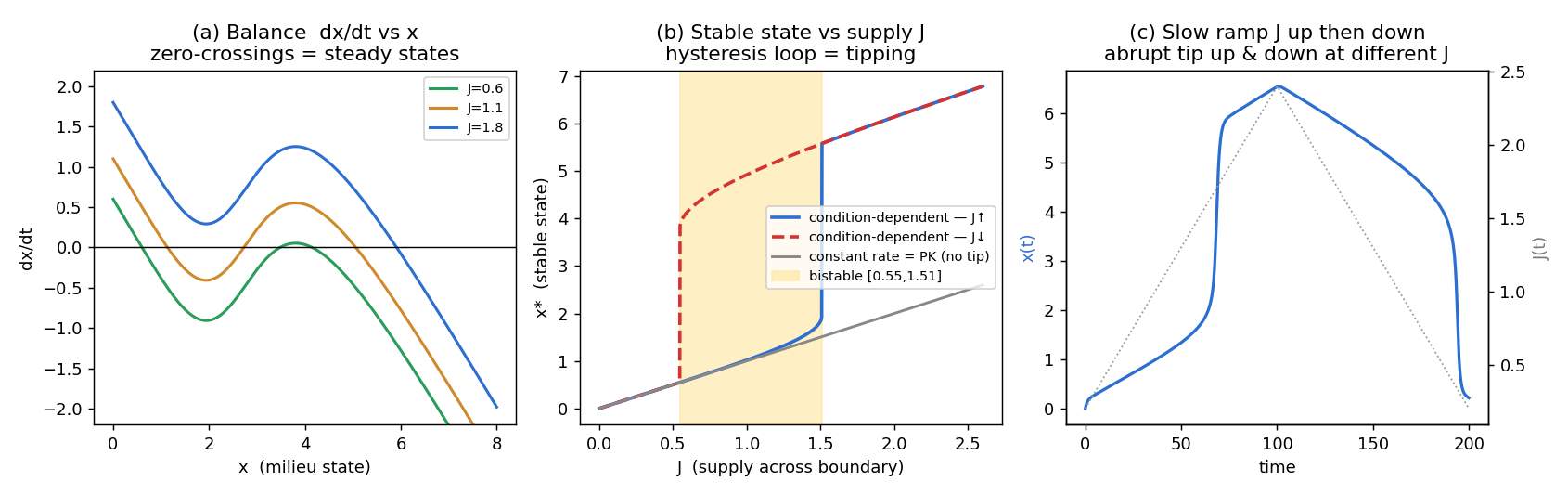
The tipping and its history-dependence are system properties that no constant-rate compartment model reproduces; they appear exactly where the transfer rate at the boundary depends on the state of the adjacent milieu. This is an illustration that the distinction is mathematically real — not a claim that a particular physiological boundary is bistable, which would require measured, state-dependent rates for a concrete case (the immune-interface test, §8 third point, is the natural candidate). Reproducible: models/tipping_model_FORSCH-0211.py.
9 · NODES
This work makes FORSCH-0111 §5b independent (seed, remains version-closed) and ties to FORSCH-0111 §5a (locus of balance), FORSCH-0115 (liver-brain, carrier/barrier), FORSCH-0061 (appropriation), and to the strand “transport as noise under constraint” (textbook critique, level discipline, FORSCH-PENDING). Through the concept of milieu (Canguilhem → Foucault) there is a node to the border-regime cluster (FORSCH-0119 ff., security/milieu). The relation-instead-of-owner question-form connects the work to the ρ/δ strand (FORSCH-0083) as its application to the description of the body.
Sources
- Mark Welch JL, Hasegawa Y, McNulty NP, Gordon JI, Borisy GG (2017). Spatial organization of a model 15-member human gut microbiota established in gnotobiotic mice. PNAS 114(43): E9105–E9114. DOI: 10.1073/pnas.1711596114. — Colon as an incompletely mixed bioreactor (mouse model).
- Zaborin A, Penalver Bernabe B, Keskey R, Sangwan N, Hyoju S, Gottel N, Gilbert JA, Zaborina O, Alverdy JC (2020). Spatial Compartmentalization of the Microbiome between the Lumen and Crypts Is Lost in the Murine Cecum following the Process of Surgery. mSystems 5(3): e00377-20. DOI: 10.1128/mSystems.00377-20. — Loss of lumen/crypt compartmentalization under physiological stress.
- Douglas AE, Werren JH (2016). Holes in the Hologenome: Why Host-Microbe Symbioses Are Not Holobionts. mBio 7(2): e02099-15. DOI: 10.1128/mBio.02099-15. — Critique of the unit-of-selection reading; hologenome not a null hypothesis.
- Moran NA, Sloan DB (2015). The Hologenome Concept: Helpful or Hollow? PLOS Biology 13(12): e1002311. DOI: 10.1371/journal.pbio.1002311. — Separate critique of the hologenome concept.
- Bordenstein SR, Theis KR (2015). Host Biology in Light of the Microbiome: Ten Principles of Holobionts and Hologenomes. PLOS Biology 13(8): e1002226. DOI: 10.1371/journal.pbio.1002226. — Holobionts are not organ systems/superorganisms (defense with limits).
- Canguilhem G (2008 [Fr. 1965]). The Living and Its Milieu. In: Knowledge of Life (trans. Geroulanos & Ginsburg), Fordham University Press, pp. 98–120. — Milieu as an inside/outside-symmetric relation (organism as milieu of the parts); shaped by Uexküll’s Umwelt.
- Canguilhem G (1991 [Fr. 1966]). The Normal and the Pathological. Zone Books. — Normality as the capacity to adapt to a changing milieu.
- Foucault M (2007 [lectures 1977–1978]). Security, Territory, Population. — Political concept of milieu following Canguilhem (node, not unfolded).
WERKSTATTLINIE v2.0 — SACHLICHKEIT. Textbook-relation satisfied (literature check before all markings). Before Zenodo: E28 trace-separation scan (Exit 0 required), final DOI verification (done in v1.1: 5 sources verified), number final 0211.
© 2026 Thomas Schüller. Licensed under CC BY 4.0.
ORCID: 0009-0003-9799-6747 · Contact: forschung@tschueller.com · Work ID: FORSCH-0211 · Version 1.4