Register der WerkeRegister of works
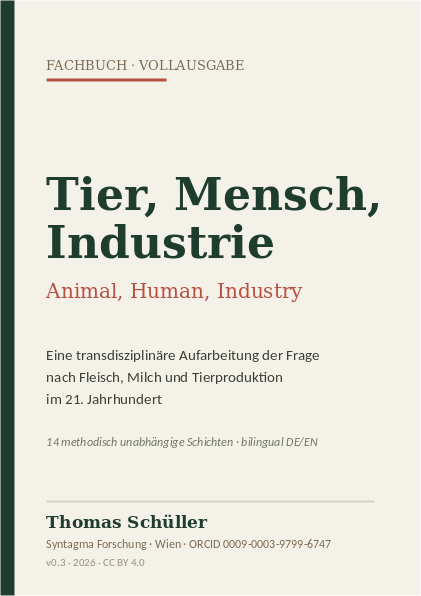
Tier, Mensch, Industrie – Fleisch, Milch und Tierproduktion im 21. Jahrhundert
Animal, Human, Industry – Meat, Milk and Animal Production in the 21st Century
Vierzehnschichtige transdisziplinäre Synthese zur industriellen Tierproduktion: Ernährung und Medizin, Ökologie und Klima, Gesundheitsökonomie, Recht, Tierethik, politische Ökonomie, Welternährung. Synthese-Paper, Spin-offs, neun Vertiefungen, Quellenkritik und Pamphlet frei; Fachbuch als Vollausgabe erhältlich.
Fourteen-layer transdisciplinary synthesis on industrial animal production: nutrition and medicine, ecology and climate, health economics, law, animal ethics, political economy, world food. Synthesis paper, spin-offs, nine deep dives, source criticism and pamphlet free; textbook available as full edition.
- KennungIdentifier
- FORSCH-0090FORSCH-0090
- StandStatus
- publikationsbereitready for release
- FeldField
- Leben, Ernährung, StoffwechselLife, nutrition, metabolism
- ThemaTopic
- Tiere, Tierethik und TierversuchAnimals, animal ethics and animal testing
- WerkreiheSeries
- Tiere und TierethikAnimals and animal ethics
- ErschienenPublished
- 14.10.2026
- AutorAuthor
- Thomas Schüller ORCID
- LizenzLicence
- CC BY 4.0
- DOI
- noch nicht eingetragennot yet recorded · Zenodo-Einträge der PersonZenodo records of the author
Dateien
Files
Verbunden mit
Connected with
- Vegan cheeseVeganer Käse
- Ernährungssouveränität – wer über die Bedingungen der Nahrungserzeugung verfügtFood sovereignty – who controls the conditions of food production
Aus der Werkreihe
From the series
Tiere und TierethikAnimals and animal ethics · 9 Werkeworks
- Vergleichende Verwilderungs-Sensorik – ein transdisziplinäres FrameworkComparative feralisation sensing – a transdisciplinary framework
- Tierversuche Zulassung SimulationTierversuche Zulassung Simulation
- NAM — Evidenz, Ethik, HaftungNAM — Evidenz, Ethik, Haftung
- Gerechtigkeit für Tiere — Nussbaums Capabilities-Ansatz als neue Theorie der TierethikJustice for Animals — Nussbaum's Capabilities Approach as a New Theory of Animal Ethics
- Das gezuechtete KapitalBred Capital — politische Oekonomie der Tierzucht und des Tiereinsatzes, mit biologischer Grundlage
- Tierversuch-StrangAnimal-Experimentation Line — Korpus
- The-Honeybee-as-Industrial-StressorThe-Honeybee-as-Industrial-Stressor
- Qualzucht als Vorlauf-Modell humaner DesignerbiologieQualzucht als Vorlauf-Modell humaner Designerbiologie
Zitieren
Cite
Schüller, T. (2026). Tier, Mensch, Industrie – Fleisch, Milch und Tierproduktion im 21. Jahrhundert (FORSCH-0090). Syntagma Forschung, Wien. https://syntagma-science.com/werke/tier-mensch-industrie/
Schüller, T. (2026). Animal, Human, Industry – Meat, Milk and Animal Production in the 21st Century (FORSCH-0090). Syntagma Forschung, Vienna. https://syntagma-science.com/werke/tier-mensch-industrie/
BibTeX
@misc{schueller2026tiermenschindustrie,
  author    = {Schüller, Thomas},
  title     = {Tier, Mensch, Industrie – Fleisch, Milch und Tierproduktion im 21. Jahrhundert},
  year      = {2026},
  publisher = {Syntagma Forschung, Wien},
  url       = {https://syntagma-science.com/werke/tier-mensch-industrie/},
  number    = {FORSCH-0090},
  note      = {CC BY 4.0}
}
Syntax-Karte
Syntax card
Das Werk in der Syntagma-Syntax 1.0: 2 Frage · 2 Gegenstand · 1 Annahme · 6 Begriff · 10 Satz · 10 Quelle · 2 Hypothese · 2 Prüfung · 1 Methode · 2 Messgröße · 4 Grenze · 3 Offen. Stufen G0–G5 geben die Beleglage an, T1–T6 die Art der Quelle.
The work in Syntagma Syntax 1.0. Levels G0–G5 give the state of evidence, T1–T6 the kind of source.
- Wie sollten Menschen in industrialisierten Gesellschaften des 21. Jahrhunderts mit Tieren, ihrem Fleisch, ihren Sekretionen und ihrem Tod umgehen?How should people in industrialised societies of the 21st century deal with animals, their meat, their secretions and their death?
- Trägt die Konvergenz methodisch unabhängiger Schichten eine Diagnose, die keine einzelne Schicht allein trägt?Does the convergence of methodologically independent layers carry a diagnosis that no single layer carries alone?
Alle Glieder anzeigenShow all elements
| GliedElement | StufeLevel | AussageStatement |
|---|---|---|
| F1 FrageQuestion | Wie sollten Menschen in industrialisierten Gesellschaften des 21. Jahrhunderts mit Tieren, ihrem Fleisch, ihren Sekretionen und ihrem Tod umgehen?How should people in industrialised societies of the 21st century deal with animals, their meat, their secretions and their death? | |
| F2 FrageQuestion | Trägt die Konvergenz methodisch unabhängiger Schichten eine Diagnose, die keine einzelne Schicht allein trägt?Does the convergence of methodologically independent layers carry a diagnosis that no single layer carries alone? | |
| G1 GegenstandObject | Industrielle Tierproduktion: Fleisch, Milch, Aquakultur und Fischerei samt Industrie, Arbeit und PolitikIndustrial animal production: meat, milk, aquaculture and fisheries including industry, labour and politics | |
| G2 GegenstandObject | Menschliche Ernährung in evolutionärer, anatomischer, biochemischer und genetischer SichtHuman diet from evolutionary, anatomical, biochemical and genetic perspectives | |
| A1 AnnahmeAssumption | Das Werk schreibt offen von einer marxistisch-materialistischen Position aus; die Vorprägung wird durch eine ETHOSLAB-Vorprüfung und Quellenkritik-Annexe kontrolliert, Industriequellen werden geprüft und nicht wegen ihrer Finanzierung verworfenThe work is openly written from a marxist-materialist position; this orientation is controlled by an ETHOSLAB pre-inquiry and source-critique annexes, and industry sources are examined rather than dismissed because of their funding | |
| B1 BegriffTerm | Mendelian Randomization := Methode, die genetische Varianten, die einen Risikofaktor lebenslang heben oder senken, als natürliches Experiment für Kausalität nutztMendelian randomisation := method using genetic variants that raise or lower a risk factor for life as a natural experiment for causality | |
| B2 BegriffTerm | Lactase-Persistenz := genetische Variante, die Laktoseverdauung im Erwachsenenalter erlaubt; global bei etwa 35 % der ErwachsenenLactase persistence := genetic variant allowing lactose digestion in adulthood; globally in about 35 % of adults | |
| B3 BegriffTerm | Externalisierung := Verlagerung ökologischer, gesundheitlicher und sozialer Kosten aus der Bilanz der Produzenten auf DritteExternalisation := shifting ecological, health and social costs out of the producers' accounts onto third parties | |
| B4 BegriffTerm | Carnismus := Ideologie, die Fleischkonsum als natürlich, normal und notwendig erscheinen lässt (Joy 2010)Carnism := ideology that makes meat consumption appear natural, normal and necessary (Joy 2010) | |
| B5 BegriffTerm | Metabolic Rift := Marx'sche Kategorie (über Foster) für den kapitalistischen Bruch des StoffkreislaufsMetabolic rift := Marxian category (via Foster) for the capitalist rupture of the material cycle | |
| B6 BegriffTerm | Naturalistischer Fehlschluss := Schluss vom Sein auf das Sollen, hier von der evolutionären Rolle des Fleisches auf heutige ErnährungsnormenNaturalistic fallacy := inference from is to ought, here from the evolutionary role of meat to present dietary norms | |
| S1 SatzStatement | G3 | Kontrolliert man die Stichprobengröße, verschwindet der scheinbare Anstieg archäologischer Belege für Fleischverzehr mit dem Auftreten von Homo erectusWhen sample size is controlled for, the apparent rise in archaeological evidence for meat eating with the appearance of Homo erectus disappears |
| S2 SatzStatement | U | Psilocybin-haltige Pilze lieferten den entscheidenden Schub für die Hirnvergrößerung der Hominiden (Stone-Ape-These) – im Kern unfalsifizierbar formuliert und empirisch unbelegtPsilocybin mushrooms supplied the decisive push for hominin brain enlargement (stoned ape thesis) – essentially unfalsifiable as stated and empirically unsupported |
| S3 SatzStatement | G5 | LDL-Cholesterin ist kausal mit dem kardiovaskulären Risiko verbunden; da gesättigte tierische Fette LDL heben, ist die Diet-Heart-Kette in modifizierter Form gestütztLDL cholesterol is causally linked to cardiovascular risk; since saturated animal fats raise LDL, the diet-heart chain is supported in modified form |
| S4 SatzStatement | G2 | Hoher Konsum von rotem und verarbeitetem Fleisch erhöht das Typ-2-Diabetes-Risiko kausal – die beobachtende Evidenz ist stark, die Mendelian-Randomization-Befunde sind uneinheitlichHigh consumption of red and processed meat causally raises type 2 diabetes risk – observational evidence is strong, Mendelian randomisation findings are mixed |
| S5 SatzStatement | G3 | In EPIC-Oxford hatten Vegetarier eine um 22 % niedrigere Rate ischämischer Herzkrankheit, zugleich eine um 20 % höhere SchlaganfallrateIn EPIC-Oxford vegetarians had a 22 % lower rate of ischaemic heart disease and at the same time a 20 % higher stroke rate |
| S6 SatzStatement | G4 | Pflanzenbetonte Ernährung mit niedrigem Anteil an rotem und verarbeitetem Fleisch senkt kardiovaskuläres Risiko, Typ-2-Diabetes-Inzidenz, einige Krebsarten und GesamtmortalitätPlant-forward diets with a low share of red and processed meat lower cardiovascular risk, type 2 diabetes incidence, some cancers and all-cause mortality |
| S7 SatzStatement | G3 | Etwa 77 % der globalen landwirtschaftlichen Nutzfläche dienen der Tierproduktion, die etwa 18 % der globalen Kalorienversorgung liefertAbout 77 % of global agricultural land serves animal production, which supplies about 18 % of global calories |
| S8 SatzStatement | G3 | Tierproduktion verursacht je nach Bilanzierung zwischen 11 % und 19,6 % der anthropogenen Treibhausgasemissionen; das Werk liest die Spanne als 14–20 %Depending on accounting, animal production causes between 11 % and 19.6 % of anthropogenic greenhouse gas emissions; the work reads the range as 14–20 % |
| S9 SatzStatement | G3 | Etwa 60 % der Infektionskrankheiten des Menschen und etwa 75 % der neu auftretenden haben tierischen UrsprungAbout 60 % of human infectious diseases and about 75 % of emerging ones are of animal origin |
| S10 SatzStatement | G3 | Für 2019 werden weltweit etwa 1,27 Millionen Todesfälle direkt antimikrobieller Resistenz zugeschriebenFor 2019 about 1.27 million deaths worldwide are directly attributed to antimicrobial resistance |
| Q1 QuelleSource | T2 | Systematische Analyse von 59 ostafrikanischen FundstellenSystematic analysis of 59 East African sites |
| Q2 QuelleSource | T2 | Prüfung der Stone-Ape-TheseAssessment of the stoned ape thesis |
| Q3 QuelleSource | T2 | EPIC-Oxford-KohorteEPIC-Oxford cohort |
| Q4 QuelleSource | T2 | Mendelian Randomization zu LDL und kardiovaskulärem RisikoMendelian randomisation on LDL and cardiovascular risk |
| Q5 QuelleSource | T2 | Kombinierte Analyse von 9 Polymorphismen in 6 Genen mit LDL-EffektCombined analysis of 9 polymorphisms in 6 genes affecting LDL |
| Q6 QuelleSource | T2 | Federierte Meta-Analyse von 1,97 Mio. Personen (InterConnect)Federated meta-analysis of 1.97 million people (InterConnect) |
| Q7 QuelleSource | T2 | Umweltwirkungen der LebensmittelproduktionEnvironmental impacts of food production |
| Q8 QuelleSource | T2 | Globale Trends neu auftretender InfektionskrankheitenGlobal trends in emerging infectious diseases |
| Q9 QuelleSource | T2 | Treibhausgasemissionen tierischer und pflanzlicher LebensmittelGreenhouse gas emissions from animal-based and plant-based foods |
| Q10 QuelleSource | T2 | Globale Last antimikrobieller Resistenz 2019Global burden of antimicrobial resistance in 2019 |
| H1 HypotheseHypothesis | G1 | Mehrere unabhängige ethische Linien (utilitaristisch, deontologisch, capability-basiert, politisch-relational, feministisch) führen übereinstimmend zum Schluss, dass Tierausbeutung im industriellen Maßstab nicht zu rechtfertigen istSeveral independent ethical lines (utilitarian, deontological, capability-based, political-relational, feminist) converge on the conclusion that animal exploitation on an industrial scale cannot be justified |
| P1 PrüfungTest | Fällt, wenn eine in sich konsistente ethische Theorie industrielle Tierproduktion bei verfügbaren pflanzlichen Alternativen begründet rechtfertigtFails if an internally consistent ethical theory justifies industrial animal production when plant-based alternatives are available | |
| H2 HypotheseHypothesis | G1 | TMAO verursacht das erhöhte kardiovaskuläre Risiko mit und ist nicht nur MarkerTMAO contributes causally to raised cardiovascular risk and is not merely a marker |
| P2 PrüfungTest | Fällt, wenn Mendelian-Randomization- oder Interventionsstudien TMAO als reinen Marker ohne eigenen kausalen Beitrag ausweisenFails if Mendelian randomisation or intervention studies identify TMAO as a mere marker without its own causal contribution | |
| M1 MethodeMethod | Vierzehn methodisch unabhängige Schichten von der Paläoanthropologie bis zur marxistischen Synthese, zusammengeführt als Konsilienz; Quellen begutachtet, mit DOI, Effektgrößen, Replikationsstatus und Finanzierungsquellen; Quellenkritik zu vier industriefinanzierten Studien und vier marginalen HypothesenFourteen methodologically independent layers from palaeoanthropology to a marxist synthesis, combined as consilience; peer-reviewed sources with DOI, effect sizes, replication status and funding sources; source critique of four industry-funded studies and four marginal hypotheses | |
| X1 MessgrößeMeasure | Hazard Ratio für Krankheits- oder Sterberaten im KohortenvergleichHazard ratio for disease or mortality rates in cohort comparison | |
| X2 MessgrößeMeasure | Anteil der Tierproduktion an den anthropogenen TreibhausgasemissionenShare of animal production in anthropogenic greenhouse gas emissions | |
| L1 GrenzeLimit | Kein Konsumratgeber und ausdrücklich nicht neutral; die Position ist deklariertNot a consumer guide and explicitly not neutral; the position is declared | |
| L2 GrenzeLimit | Keine universelle moralische Pflicht, die gleichförmig auf Subsistenz-, Kleinbauern- und indigene Kontexte ausgedehnt wirdNo universal moral obligation extended uniformly to subsistence, smallholder and indigenous contexts | |
| L3 GrenzeLimit | Kein bestimmtes politisches Programm; die Diagnose ist robuster als jede ihrer politischen FolgerungenNo specific political programme; the diagnosis is more robust than any of its policy implications | |
| L4 GrenzeLimit | Evolutionäre und genetische Befunde sind deskriptiv und liefern keine moralische Rechtfertigung für oder gegen FleischkonsumEvolutionary and genetic findings are descriptive and provide no moral justification for or against meat consumption | |
| O1 OffenOpen | Ausarbeitung eines politischen ÜbergangsrahmensDevelopment of a political transition framework | |
| O2 OffenOpen | Offene Fragen einer marxistischen Tierethik, die heute eher Programm als Bestand istOpen questions of a marxist animal ethics, which today is more programme than established body | |
| O3 OffenOpen | Weiterentwicklung der Alternativpfade (Präzisionsfermentation, kultiviertes Fleisch, Algen, Pilze, Insekten), die unterschiedlich reif sindFurther development of alternative pathways (precision fermentation, cultivated meat, algae, fungi, insects), which differ in maturity |
Was ist die Syntagma-Syntax?What is Syntagma Syntax? · In SATZBAU öffnenOpen in SATZBAU · JSON
Aus der Gemeinschaft
From the community
Noch keine veröffentlichten Beiträge zu diesem Werk.
No published contributions to this work yet.
Hinweis, Quelle oder Frage beitragenContribute a note, source or question Patenschaft für diese WerkreiheSponsor this series
Änderungsprotokoll
Change log
| DatumDate | ÄnderungChange |
|---|---|
| 2026-09-24 | Aufnahme ins RegisterAdded to the register |